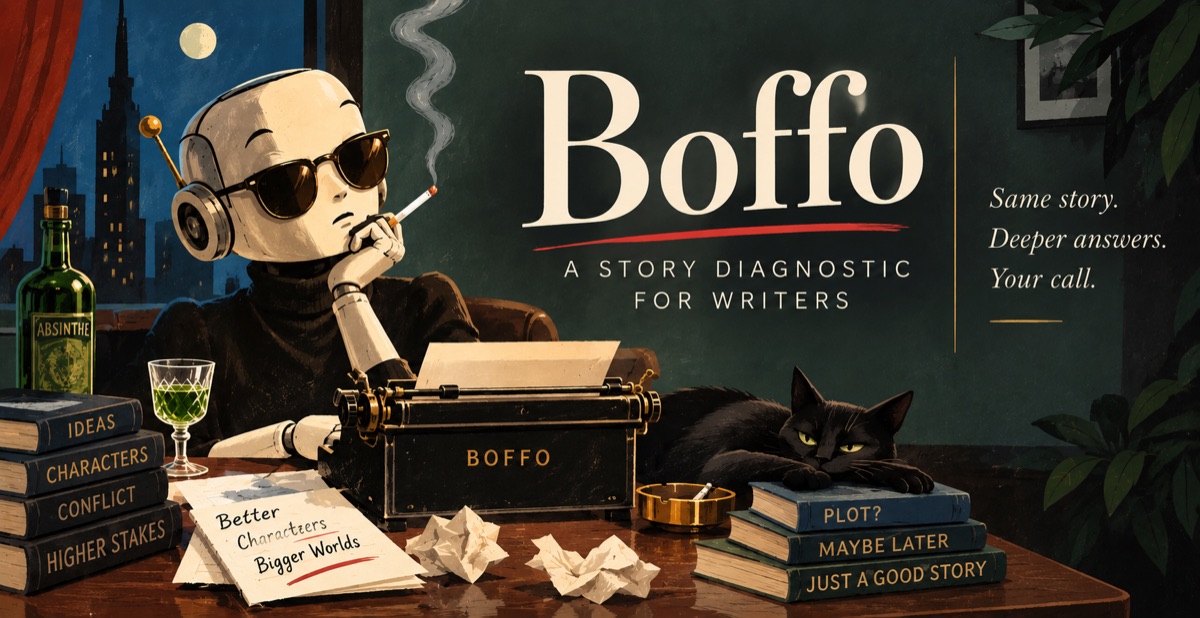
You want to write a blockbuster.
Boffo knows what's stopping you.
A novel readers can't put down. A screenplay producers fight over. Characters people remember years later.
That's the ambition. And ambition is no substitute for a story that works.
Meet Boffo, the AI fiction editor built to find what's standing between the story you've written, the story you want to tell, and the story audiences crave.
He won't write it for you. He'll tell you where it's going wrong, show you the evidence, and help you make it better.
Free Claude skill · 14 story engines · Diagnose, Develop, Revise
Your friends are too kind. Your AI is too agreeable. Your agent and your readers will be neither.
You know the scene. You've rewritten it six times. Every sentence is polished. The dialogue sparkles.
And it's still boring.
Perhaps your protagonist has nothing important to lose. Perhaps the big revelation changes nothing. Perhaps the story you think you're telling isn't the story on the page.
A conventional AI will offer encouragement, rewrite your dialogue, and suggest raising the stakes.
Boffo will tell you which stakes aren't high enough, why they matter, and where your story fails to earn them.
That's the difference between improving the writing and improving the story.
Meet the editor who doesn't want your job.
Boffo was built around a simple conviction: the writer should write. The editor should find out what's not working.
He examines your fiction using 14 specialized story engines, informed by the craft principles of Robert McKee, John Truby, Blake Snyder, and other accomplished teachers of storytelling.
He's interested in the things that make fiction irresistible:
- Characters who want something badly enough to act. And whose choices have consequences.
- Conflict that changes the story. Not noise, arguments, or artificial jeopardy.
- Scenes that earn their place. Every scene should do something the story cannot afford to lose.
- Revelations that matter. Information should change what a character, or reader, understands.
- Promises made and promises kept. The setup, surprise, and payoff that make readers glad they stayed.
Boffo doesn't insist on a formula. He asks whether your story delivers on its own promise.
One editor. Three jobs.
1. Diagnose
Find the problems.
Boffo reads your pages, selects the appropriate story engines, and identifies weakness doing damage. Not 37 suggestions. Not a lecture about showing rather than telling. The problem worth fixing first—with evidence from your own writing.
2. Develop
Find the stronger story hiding inside the one you've written.
Suppose your protagonist made the opposite choice. Suppose the revelation came earlier. Suppose the scene you've fallen in love with disappeared.
Boffo examines possible directions, their dramatic consequences, and what each might cost you.
He doesn't choose your story. He helps you see your choices.
3. Revise
Find out whether your brilliant fix will actually work.
Every revision has consequences. Strengthen one character and you may weaken another. Move a revelation and you may destroy a surprise.
Boffo puts your proposed changes on trial before you commit to them.
You remain the author. Always.
The Process.
-
 1
He chooses.
Boffo examines what you've given him and selects the story engines that can do the most useful work.
-
 2
He reads.
He looks for dramatic cause and effect, character choices, conflict, change, and payoff.
-
 3
He reports.
You receive a diagnosis supported by evidence from your pages, with possible next moves.
-
 4
You decide.
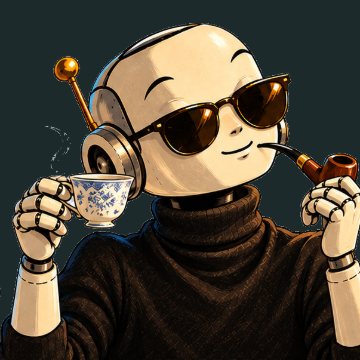
Challenge him. Ask questions. Run another pass. He can take the criticism he dishes out. Then he takes his tea.
Boffo has 14 engines. He knows better than to start all 14.
One story needs a closer look at character motivation. Another has a structural problem. A third is full of conflict that never produces a meaningful change.
Boffo selects the two or three engines most relevant to the work in front of him.
He also knows that a proposed fix can create new problems. He weighs those consequences rather than handing you an unexamined checklist.
And when he needs to ask you something, he limits himself to two questions that could genuinely change the diagnosis.
Want less diplomacy? Choose Harsh mode. Same analysis. Less cushioning.
Read the craft principles behind the engines in Story Techniques.
What Boffo won't do.
He won't insist every novel follow three acts. He won't prescribe a romance, invent a villain, or demand a car chase.
He won't mistake unconventional storytelling for bad storytelling.
He won't tell you to raise the stakes unless he can explain which stakes, where, and why.
And he won't flatter you into believing a story works when his evidence says otherwise.
Boffo is not here to make you feel like a better writer. He's here to help you become one.
The next blockbuster won't write itself.
You may have already written the scene that makes your book unforgettable.
You may also have written the scene that's killing it.
Wouldn't you like to know which is which?
Give Boffo a scene to read →Paste your fiction. Choose a mode. Read his diagnosis. You get three follow-up questions to challenge the findings or explore the possibilities.
The live demo is currently available by invitation. Request access here.
And Boffo is free.
Boffo is an open Claude skill. Install it in Claude, use it on your own fiction, and share it with other writers.
No publishing contract. No editorial ego. No percentage of your future royalties.
You bring the story. Boffo brings the questions that make it better.