Eighteen books on how complexity, meaning, and knowledge hold together, each written up at length rather than starred out of five
Book list curated by @myxfamily · Summaries written for this page
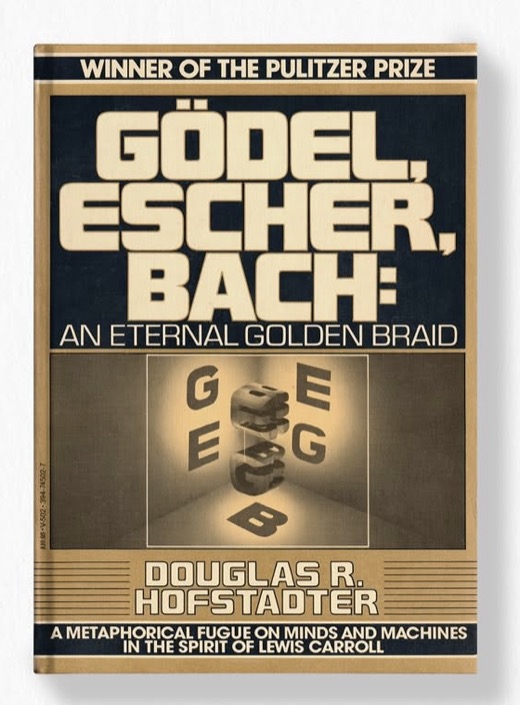
Gödel, Escher, Bach: An Eternal Golden Braid
Douglas R. Hofstadter, 1979
This sprawling, Pulitzer Prize-winning book explores how meaning and self-awareness can emerge from formal systems that, on their own, contain no meaning at all. Hofstadter braids together three seemingly disconnected figures: the mathematician Kurt Gödel, whose incompleteness theorems showed that any sufficiently powerful formal system contains true statements it cannot prove; the artist M. C. Escher, whose drawings depict impossible loops and self-referential structures; and the composer J. S. Bach, whose fugues and canons build complexity out of simple repeating patterns. Interspersed between chapters of analysis are whimsical Socratic dialogues starring Achilles and the Tortoise, which dramatize abstract ideas like recursion, self-reference, and paradox through playful wordplay and puzzles. Hofstadter's central argument is that consciousness and intelligence are not mysterious extra ingredients added to a brain, but "strange loops," patterns that arise when a system becomes complex enough to represent and refer to itself. He draws on formal logic, molecular biology, computer science, linguistics, and Zen koans to build this case, anticipating later debates in cognitive science and AI about whether machines can think. The book is famous for being simultaneously rigorous and playful, using puns, acrostics, and typographical games to enact the very ideas it describes. Though dense and idiosyncratic, it became an unlikely bestseller and a foundational text for people interested in AI, cognitive science, and philosophy of mind, prized for making abstract mathematical logic feel personal, funny, and urgent.
The Nag Hammadi Library
James M. Robinson (editor), 1977 (texts themselves date to roughly the 2nd–4th centuries)
In 1945, an Egyptian farmer digging near the town of Nag Hammadi unearthed a sealed jar containing thirteen leather-bound papyrus codices, buried for roughly sixteen centuries. This volume, edited by James M. Robinson, presents the first complete English translation of that discovery: over fifty texts written mostly in Coptic, including the Gospel of Thomas, the Gospel of Philip, the Apocryphon of John, and the Gospel of Truth, along with various Gnostic treatises and fragments of Hermetic and Platonic philosophy. These writings preserve the voices of early Christian and quasi-Christian communities whose beliefs were later branded heretical and suppressed by the emerging orthodox church; many scholars believe the codices were hidden by monks to protect them from destruction after being condemned. Rather than centering on Christ's death and resurrection as atonement, many of these texts emphasize direct, experiential knowledge (gnosis) of the divine spark within the self as the path to salvation, often portraying the material world as a flawed creation. The collection reopened scholarly and popular understanding of how varied and contested early Christianity actually was before doctrinal orthodoxy consolidated. Robinson's edition, with introductions to each text and accessible translations, made these previously obscure or destroyed writings available to a general readership for the first time, influencing academic theology and popular depictions of "lost gospels" and alternative Christian history alike.
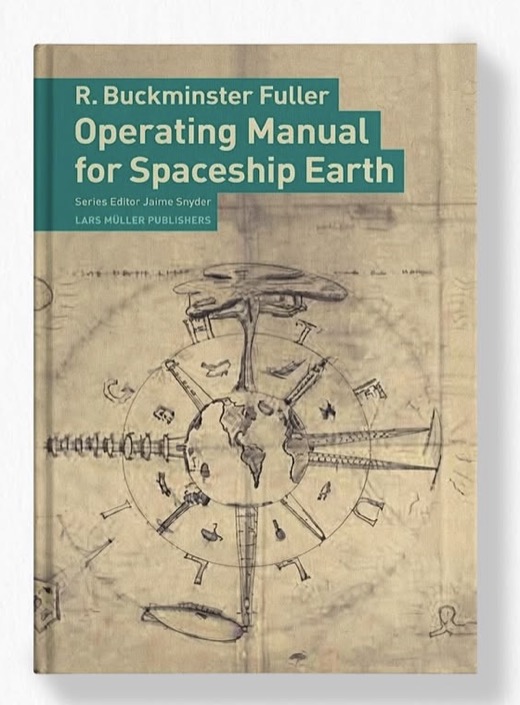
Operating Manual for Spaceship Earth
R. Buckminster Fuller, 1969
Buckminster Fuller, the visionary engineer and inventor best known for the geodesic dome, wrote this slim, dense book to reframe how humanity understands its situation on Earth. His central conceit: human beings have been given an extraordinarily sophisticated vehicle, the planet itself, without ever receiving an instruction manual for how to operate it responsibly. Fuller argues this omission isn't an accident but a consequence of specialization: because Earth's life-support systems work automatically and invisibly, most people never learn how they function, leading to waste, conflict, and mismanagement of finite resources. Drawing on his background in engineering and architecture, Fuller lays out a case for "comprehensive anticipatory design science," a systems-thinking approach treating humanity's problems as interconnected engineering challenges rather than isolated political disputes. He is relentlessly optimistic, arguing technology and efficient design, not scarcity, will determine whether humanity thrives, and that a shift from "weaponry" to "livingry" (technology in service of life rather than destruction) could make abundance available to everyone. The book touches on solar energy, industrialization, the history of specialization, and his idea of "ephemeralization," the tendency of technology to do more with less material over time. Written in Fuller's famously idiosyncratic prose, full of invented terminology and sweeping historical claims, the book became a foundational text for environmentalists, systems thinkers, and designers, anticipating later conversations about sustainability and global stewardship.
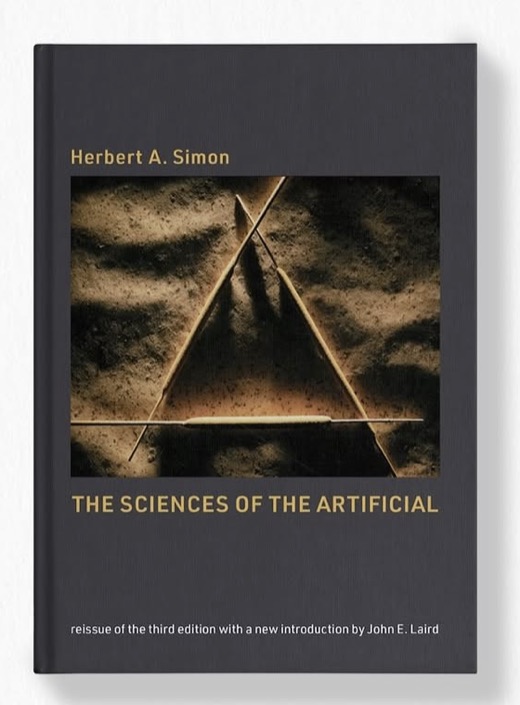
The Sciences of the Artificial
Herbert A. Simon, 1969
Herbert Simon, a Nobel laureate in economics who was also a founding figure in artificial intelligence and cognitive science, argues here for a unified science of "artificial" things, meaning things designed by people to achieve goals, as opposed to natural phenomena studied by traditional science. Whether the object is a business organization, a computer program, or a human mind engaged in problem-solving, Simon contends these systems share a common logic: they adapt an "inner environment" to an "outer environment" to achieve some purpose, and their behavior is best understood by studying the goals and constraints that shape their design, not by reducing them to physics. He introduces the influential idea of "bounded rationality," the observation that real decision-makers cannot possibly evaluate every option perfectly, and instead rely on heuristics and satisfactory (rather than optimal) solutions, a concept that reshaped economics, management theory, and cognitive psychology. Simon also explores how complex systems can be understood as hierarchies of simpler subsystems, using the parable of two watchmakers to illustrate why modular, hierarchical design is more robust than monolithic design. Written from his position straddling economics, psychology, computer science, and engineering, the book proposes design as a rigorous intellectual discipline in its own right, deserving the same seriousness as the natural sciences, and remains foundational reading in AI research, organizational theory, and design education.
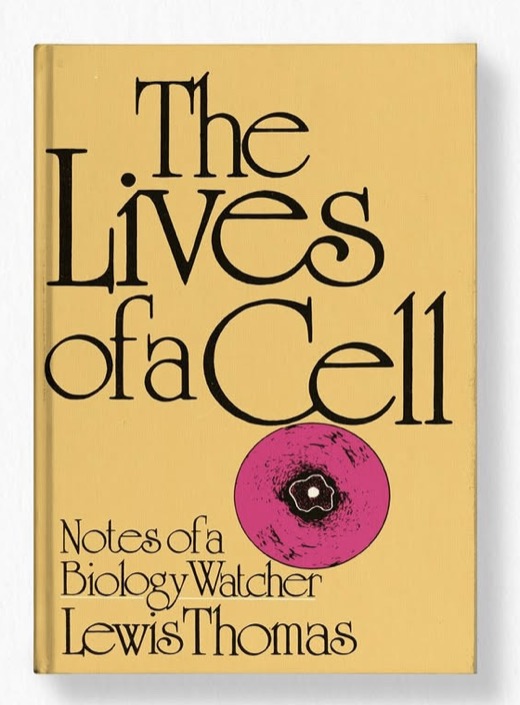
The Lives of a Cell: Notes of a Biology Watcher
Lewis Thomas, 1974
Lewis Thomas was a physician and researcher who, late in his career, began writing short essays for The New England Journal of Medicine reflecting on biology with a naturalist's eye and a poet's ear; this collection gathers those pieces and won the National Book Award. Rather than a single sustained argument, the book moves associatively through subjects like mitochondria, insect colonies, viruses, language, and human warts, using each as a lens onto Thomas's recurring insight: living systems at every scale, from a single cell to an anthill to the entire planet, tend to operate through cooperation and interdependence rather than the competitive, atomized struggle popularly associated with Darwinian biology. He famously suggests that mitochondria, the energy-producing structures inside our own cells, were once independent organisms that merged symbiotically with larger cells, meaning the human body is, in a sense, a cooperative colony rather than a single unified self. Thomas extends this outward, comparing the Earth's biosphere to a single organism, an idea that resonated with the emerging environmental movement and echoes James Lovelock's roughly contemporaneous Gaia hypothesis. His tone throughout is warm, curious, and often wry, treating scientific observation as a source of wonder rather than cold detachment. The essays are short, making the book accessible as well as scientifically rich, and it remains a touchstone for science writing that treats literary craft as inseparable from clear thinking about nature.
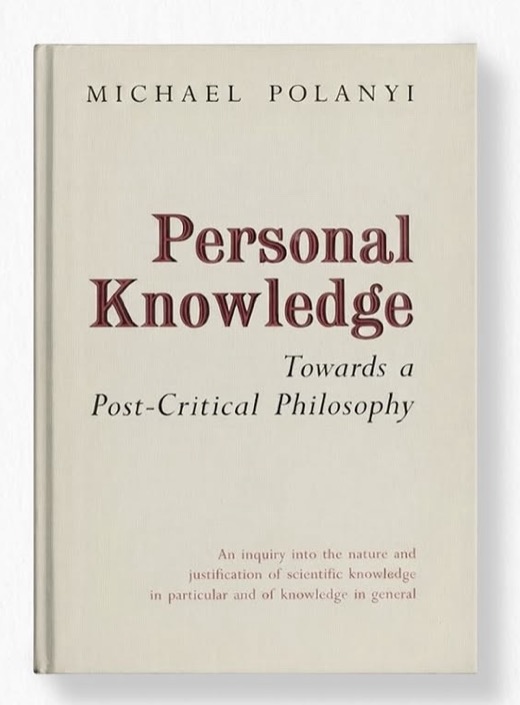
Personal Knowledge: Towards a Post-Critical Philosophy
Michael Polanyi, 1958
Michael Polanyi began his career as a physical chemist before turning to philosophy, and this book, generally considered his major work, argues against the idea that scientific knowledge is or should be purely objective, impersonal, and detached from the knower. Polanyi contends that all knowing, including the most rigorous science, is grounded in "tacit knowledge," the skills, judgments, and unarticulated commitments a knower brings to any act of understanding that can never be fully spelled out in explicit rules. He illustrates this with examples like riding a bicycle or recognizing a face: a person can perform these skillfully without being able to state exactly how, because the knowledge is embodied and practiced rather than propositional. Extending this to science, Polanyi argues that even the choice of which problems are worth investigating or which theories are elegant depends on a scientist's trained judgment and passionate commitment to certain intellectual values, not mechanical application of "the scientific method." This directly challenged the positivist picture of science as a neutral, algorithmic pursuit of objective truth, insisting instead that discovery requires "personal knowledge," a fusion of the knower's skill and belief with the object known. The book had significant influence on philosophy of science (including on Thomas Kuhn), epistemology, and later discussions of expertise, and remains notable for defending the idea that passionate, embodied commitment is not an obstacle to truth but a necessary condition for attaining it.
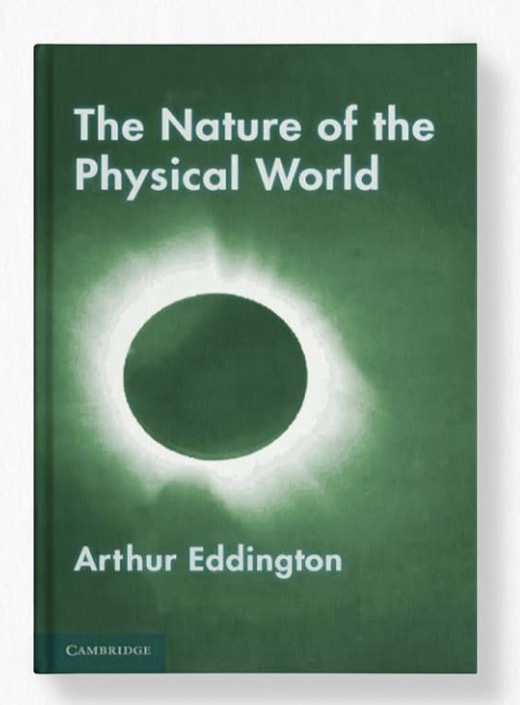
The Nature of the Physical World
Arthur Eddington, 1928
Arthur Eddington was one of the most prominent astrophysicists of the early twentieth century, famous for leading the 1919 solar eclipse expedition that gave the first observational confirmation of Einstein's general theory of relativity. This book, based on his Gifford Lectures, explains to a general audience what the revolutions of relativity and emerging quantum mechanics meant, not just for physics, but for how human beings should understand reality itself. Eddington walks readers through curved spacetime, the constancy of the speed of light, and the strange probabilistic behavior of subatomic particles, using accessible analogies rather than mathematics. He is especially interested in the gap between the "two tables" (the solid wooden table we perceive with our senses, and the mostly-empty swarm of subatomic particles that physics tells us actually constitutes it), and uses this gap to argue that physical science describes structure and relation, not the intrinsic nature of reality. From here, Eddington moves into openly philosophical and even mystical territory, suggesting that because physics reveals reality to be built from abstract mathematical relationships rather than solid, deterministic stuff, there is more room than previously believed for free will, consciousness, and religious meaning to coexist with rigorous science. This was controversial among fellow physicists, some of whom felt Eddington strayed too far into speculation, but the book was hugely influential in shaping early twentieth-century popular understanding of relativity and quantum theory, and in opening a lasting conversation about the boundary between physics and philosophy.
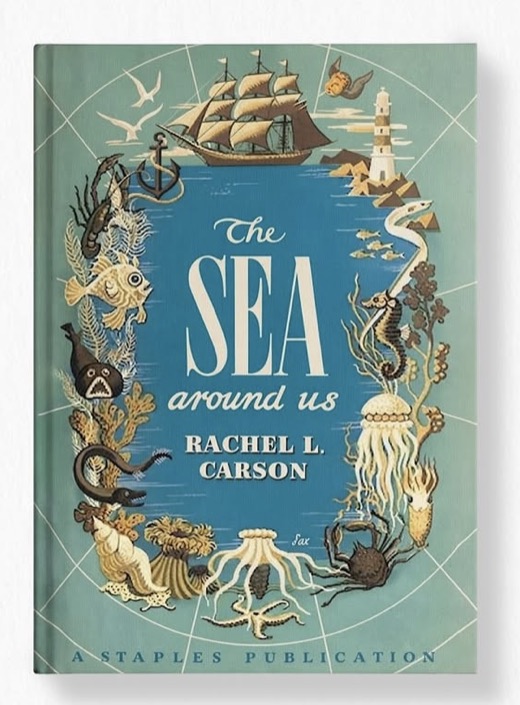
The Sea Around Us
Rachel L. Carson, 1951
Long before Silent Spring, the book that helped launch the modern environmental movement, Rachel Carson was a marine biologist working for the U.S. Fish and Wildlife Service, and The Sea Around Us was the book that made her a literary celebrity, spending well over a year on the bestseller list and winning the National Book Award. It is a sweeping, lyrical account of the ocean's origins and workings: how the seas formed billions of years ago, how life is believed to have first emerged in them, how currents, tides, and winds move water and shape climate globally, and how the ocean floor, largely unmapped at the time, holds mountain ranges and canyons rivaling those on land. Carson synthesizes an enormous amount of oceanographic, geological, and biological research, translating technical findings into vivid, precise prose that conveys the ocean's scale and strangeness without sacrificing accuracy. Although the book largely predates her more famous environmental advocacy, it already displays her conviction that patient, accurate observation of the natural world naturally produces humility and reverence, quietly building a picture of the ocean as an ancient, dynamic, interconnected system rather than a static backdrop to human affairs. The book's success rested substantially on Carson's gift for metaphor and rhythm, treating scientific exposition as a literary art form, and it established the template she would later use to devastating effect when she turned her attention to pesticides.
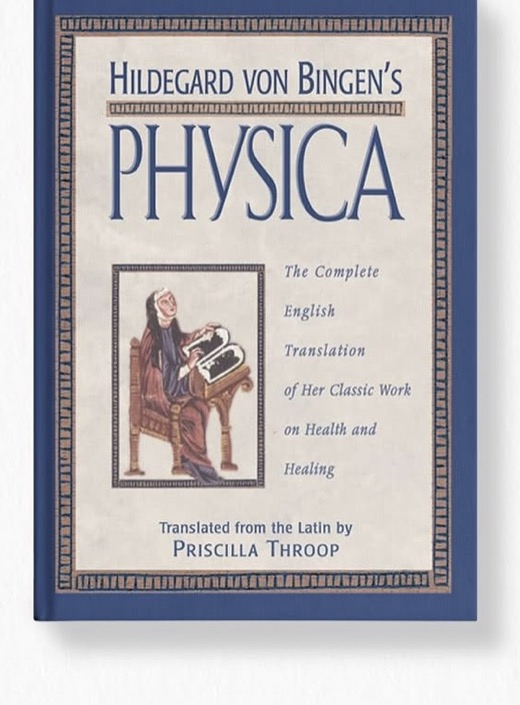
Physica
Hildegard von Bingen, c. 1150
Hildegard von Bingen was a twelfth-century Benedictine abbess, composer, mystic, and polymath whose visionary writings and correspondence with popes and emperors made her one of the most remarkable figures of medieval Europe. Physica, sometimes titled Liber Simplicis Medicinae, is her systematic catalog of the natural world's medicinal properties, organized into books covering plants, elements, trees, stones, fish, birds, animals, reptiles, and metals, with entries describing each item's qualities and uses in treating ailments. Unlike her mystical writings, which describe visionary religious experiences, Physica is grounded in practical observation, likely informed by her monastery's herb garden, regional folk medicine, and classical and Islamic medical traditions circulating in her era, blended with her own theological framework in which the natural world reflects divine order and every created thing possesses inherent healing "virtues" placed there by God. The book reflects a holistic medieval view of health in which physical ailments, spiritual condition, and the balance of bodily humors were understood as interconnected, and her remedies range from dietary advice to herbal preparations to instructions involving specific stones or animal parts. Physica is considered one of the earliest surviving natural history texts by a named European author, notably by a woman writing with clear scientific authority in an era when little women's intellectual work survived or was credited. Modern translations, like Priscilla Throop's used for this edition, have made the text accessible to readers interested in medieval medicine, women's intellectual history, and the history of science; Hildegard has since been recognized as a Doctor of the Church, one of only a handful of people, and the only woman of her era, to hold that title.
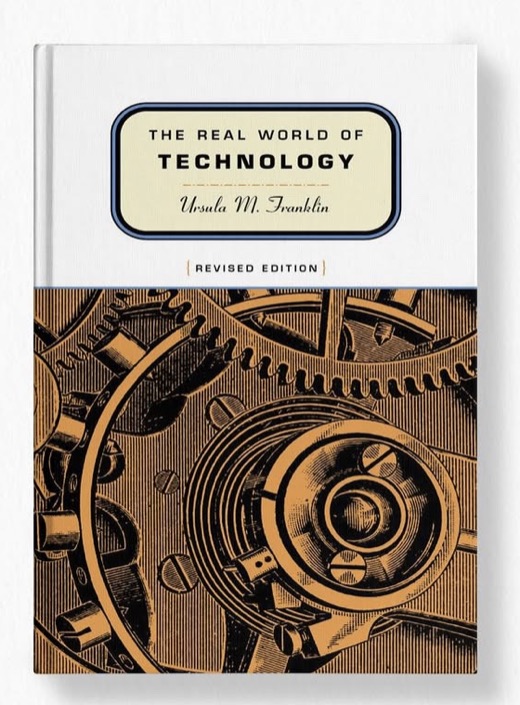
The Real World of Technology
Ursula M. Franklin, 1990
Ursula Franklin was a physicist and metallurgist who survived forced labor in Nazi Germany before emigrating to Canada, where she became a pioneering researcher and one of the first women to hold a chaired professorship in engineering. This book, based on her CBC Massey Lectures, argues against the common assumption that technology is a neutral tool that simply extends human capability without carrying its own values or politics. Franklin distinguishes between "holistic" technologies, in which a worker controls an entire process from start to finish, and "prescriptive" technologies, in which a process is broken into discrete, controlled steps performed by different people or machines, arguing that the twentieth century's shift toward prescriptive technologies, however efficient, has reorganized power in ways that discipline and control people, often without their awareness. She examines examples ranging from assembly lines to nuclear weapons to modern communication systems, arguing technological systems tend to normalize surveillance, compliance, and centralized control as side effects of their design, regardless of the intentions of the people who build them. A recurring theme is her insistence that the question to ask about any technology is not "what can it do" but "who does it benefit, and who does it do it to," reframing technological change as an inherently political and ethical matter rather than a purely technical one. Franklin's perspective, informed by her scientific expertise and her personal experience of totalitarianism, gives the book unusual moral weight, and it has become a touchstone text in science and technology studies.
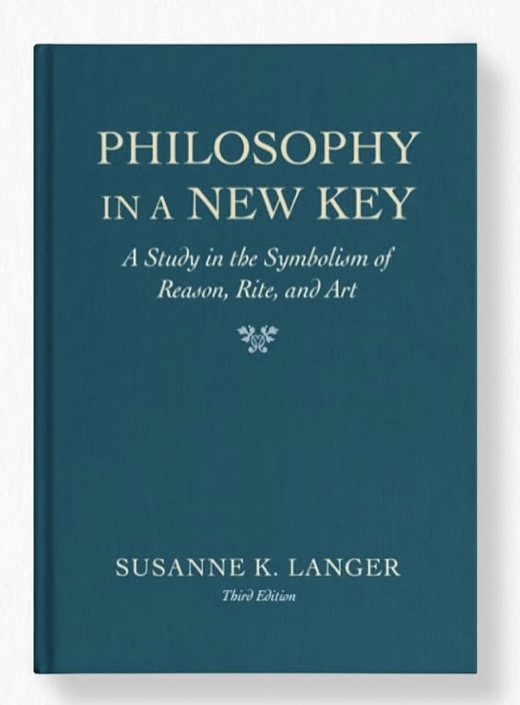
Philosophy in a New Key: A Study in the Symbolism of Reason, Rite, and Art
Susanne K. Langer, 1942
Susanne Langer, trained in the tradition of philosophers like Ernst Cassirer and Alfred North Whitehead, argues that philosophy in her era had become too narrowly focused on logical, propositional language as the sole vehicle of meaning, neglecting the vast realm of human experience conveyed through non-discursive symbols: myth, ritual, music, and visual art. She proposes that the human mind is fundamentally a symbol-making organ, constantly transforming raw sensory experience into symbolic form, and that different symbolic systems are not simply decorative alternatives to rational thought but distinct modes of understanding, each capable of expressing aspects of experience that discursive language cannot capture. Music receives particularly extensive treatment: Langer argues it expresses the dynamic form of emotional life, its patterns of tension and release mirroring the shape of felt experience, without needing to refer to any specific object the way a word does, making it a kind of symbolic language of feeling. She traces how ritual and myth similarly function as early, non-verbal ways societies organized their understanding of the world, treating them as serious cognitive achievements rather than primitive precursors to rational thought. The book's title reflects Langer's ambition to open a "new key" for philosophy, one that takes seriously the full range of human symbolic activity as central to how meaning is made. It became widely read outside academic philosophy, especially among artists, musicians, and critics, for offering a rigorous framework that validated the cognitive seriousness of art and feeling.
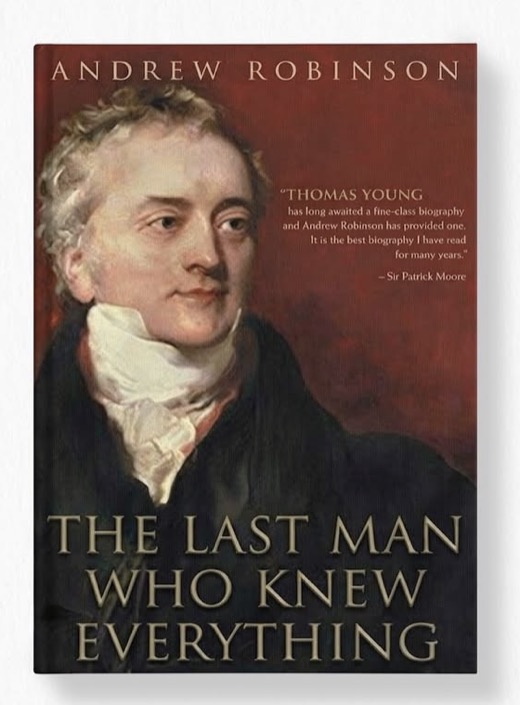
The Last Man Who Knew Everything
Andrew Robinson, 2006
This biography tells the story of Thomas Young, a nineteenth-century British polymath whose contributions span an almost unbelievable range of fields yet who remains relatively obscure compared to contemporaries like Newton or Einstein. Young performed some of the earliest work deciphering Egyptian hieroglyphs, arguably laying essential groundwork before Jean-François Champollion completed the decipherment of the Rosetta Stone; he also demonstrated, through his famous double-slit experiment, that light behaves as a wave, overturning Newton's long-dominant particle theory of light; and alongside these achievements he practiced medicine, contributed to the study of elasticity (Young's modulus is named for him), studied color perception and vision, and worked on problems in engineering and actuarial science. Robinson uses Young's life to explore both the remarkable capacities of a single mind working across disciplines and the reasons such a figure could be so thoroughly overlooked by history: Young was notoriously reluctant to publicize his work under his own name, sometimes publishing anonymously or letting credit go to others, and his personality tended toward caution rather than the self-promotion that cements scientific reputations. The book situates Young within the intellectual culture of Regency-era Britain, exploring how a gentleman scientist of his era could pursue such varied interests, and functions as a meditation on the increasing specialization of knowledge since Young's time, suggesting his kind of universal polymath may no longer be possible in an age of narrow expertise. Young died at fifty-six, and Robinson's biography works to restore him to the recognition Robinson believes he has long deserved.
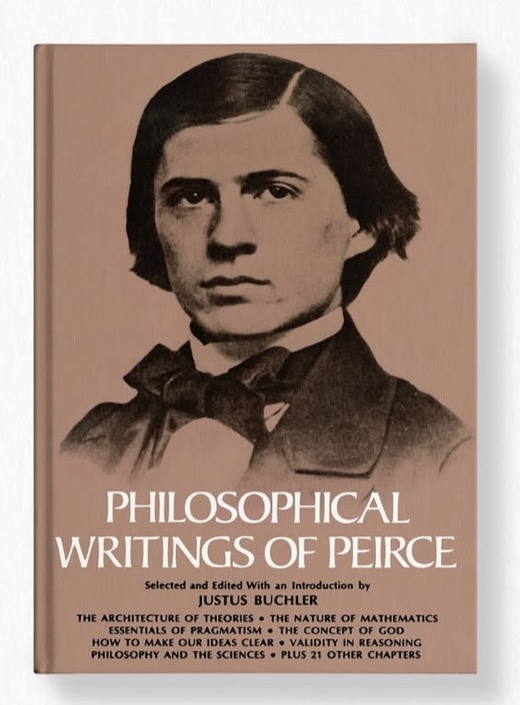
Philosophical Writings of Peirce
Charles Sanders Peirce (edited by Justus Buchler), 1940
Charles Sanders Peirce was a nineteenth-century American logician, scientist, and philosopher generally credited as the founder of pragmatism, yet during his lifetime he published relatively little compared to the vast body of manuscripts and notes he left behind, many never intended for publication, plagued as he was by institutional rejection, poverty, and personal instability. This volume, edited by philosopher Justus Buchler, gathers what was, at the time, the most accessible and representative collection of Peirce's writings across the many fields he touched: his foundational essays on pragmatism ("How to Make Our Ideas Clear" and "The Fixation of Belief"), his theory of signs (semiotics), his work in formal logic and mathematics, his philosophy of science, and his metaphysical speculations about chance, evolution, and God. Peirce's pragmatism holds that the meaning of any concept lies entirely in its practical, observable consequences, an idea that profoundly influenced later philosophers like William James and John Dewey, though Peirce felt James's popularization diverged from his own more technical intentions and eventually renamed his approach "pragmaticism" to distinguish it. Buchler's selections also showcase Peirce's lesser-known but influential triadic theory of signs, distinguishing icons, indices, and symbols, which became foundational to semiotics. Because Peirce wrote across logic, chemistry, philosophy, and mathematics without ever producing a single unified treatise, this collection remains one of the most practical ways for readers to encounter the coherence of his thought, revealing a mind that saw rigorous logic, scientific method, and questions of meaning as inseparable.
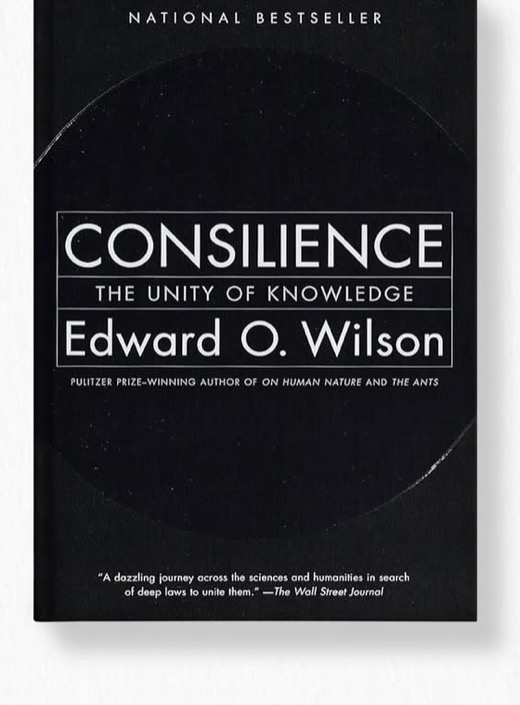
Consilience: The Unity of Knowledge
Edward O. Wilson, 1998
Edward O. Wilson, the biologist and two-time Pulitzer Prize winner best known for his work on ants and for founding the field of sociobiology, argues here for what he saw as a lost ideal: that all branches of knowledge, from physics to biology to the social sciences to the arts and ethics, are fundamentally unified and can, in principle, be linked together through consistent chains of cause and explanation. He borrows the term "consilience" from the nineteenth-century philosopher William Whewell, meaning the "jumping together" of evidence from independent sources to support a single conclusion, and argues this kind of cross-disciplinary convergence, common practice within the natural sciences, should extend to fields that have traditionally resisted it, including the humanities. Wilson contends human culture, morality, and even aesthetic taste are ultimately rooted in evolved biological processes and can eventually be explained, at least in part, through genetics, neuroscience, and evolutionary theory, without this reducing their importance. He walks through how this unifying project might apply to the social sciences, ethics (exploring whether moral intuitions have evolutionary origins), religion, and the arts, arguing throughout that specialization, while necessary for depth, has fragmented human understanding in ways that consilience could help repair. The book generated significant controversy, particularly from scholars in the humanities who saw it as an overreach of biological reductionism into domains that resist scientific reduction. Regardless of where one lands on the debate, it remains an influential and ambitious statement of the case for interdisciplinary unity from one of the twentieth century's most prominent scientists.
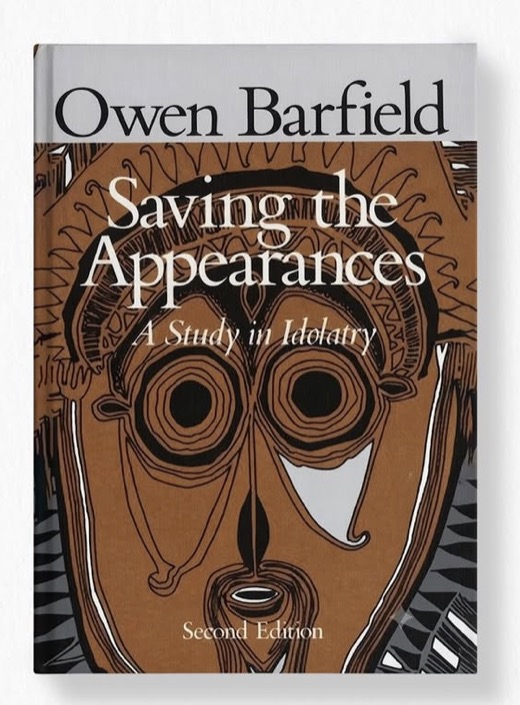
Saving the Appearances: A Study in Idolatry
Owen Barfield, 1957
Owen Barfield was a philologist, philosopher, and close friend of both C. S. Lewis and J. R. R. Tolkien (Lewis called him "the wisest and best of my unofficial teachers"), and this book, considered his major philosophical work, makes the striking argument that human consciousness itself has evolved over history, and that what earlier peoples perceived as "the world" was, in a meaningful sense, a genuinely different world from the one perceived by modern people. Barfield's central concept is "original participation": the idea that ancient and pre-modern peoples experienced natural phenomena, a thunderstorm or a river or the movement of stars, as inherently alive and meaningful, actively participating in them rather than observing them as separate, inert objects the way modern scientific consciousness does. He traces how this participatory consciousness gradually withdrew over the course of Western history, accelerated by developments like Renaissance science and Cartesian dualism, leaving modern humans with a world of "appearances" we have been trained to treat as simply, objectively "there," a collapse Barfield provocatively labels a form of "idolatry." The title refers to the phrase used by ancient astronomers who tried to "save the appearances," constructing models that accounted for observed phenomena without necessarily claiming to describe underlying reality, and Barfield argues modern science, despite its claims to objectivity, is doing something similar. He calls for a coming "final participation," a conscious, imaginative re-engagement with the world that would restore meaning without abandoning modern knowledge. Though less well known than Lewis's or Tolkien's work, it has a devoted following among readers interested in the history of consciousness and the relationship between science, myth, and imagination.
Systems of Survival: A Dialogue on the Moral Foundations of Commerce and Politics
Jane Jacobs, 1992
Jane Jacobs, best known for The Death and Life of Great American Cities, her landmark critique of mid-century urban planning, turns her attention here to why people and institutions so often behave unethically when moving between the worlds of commerce and government, even when the individuals involved are not personally corrupt. Written as a series of Socratic dialogues among characters debating the subject, the book proposes that human ethical life is organized around two distinct and internally consistent moral "syndromes": a "commercial" syndrome, built around honesty, voluntary exchange, competitiveness, innovation, and respect for contracts, suited to trade; and a "guardian" syndrome, built around loyalty, hierarchy, tradition, discipline, and the exercise of force, suited to governing and protecting territory. Jacobs argues each syndrome is coherent and morally legitimate within its own domain, but serious ethical breakdown occurs when the two get mixed: when guardians (police, politicians, bureaucrats) adopt commercial values and treat public trust as a tradeable commodity (bribery, corruption), or when commercial actors adopt guardian values and use force or secrecy to gain market advantage. The dialogue format lets Jacobs's characters test the theory against real-world cases: organized crime (framed as guardian-style commerce), Cold War military-industrial collusion, and various forms of institutional graft, refining the framework as objections arise. Though less famous than her urbanism work, the book offers a surprisingly durable lens for understanding recurring failures in business ethics, public corruption, and institutional design, still cited today in discussions of governance.
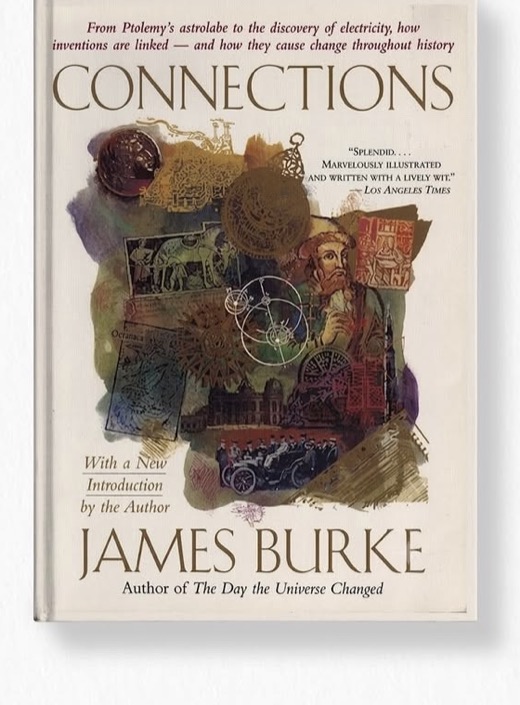
Connections
James Burke, 1978
James Burke, a British science historian and television presenter, wrote this book as a companion to his BBC documentary series of the same name, and both set out to challenge the conventional, tidy narrative of scientific and technological progress as a story of lone geniuses making isolated breakthroughs. Instead, Burke traces long, often surprising chains of interconnected inventions and events, showing how a given piece of modern technology (say, the atomic bomb, television, or the computer) can be traced back through improbable sequences of unrelated developments: a medieval agricultural innovation leads to a shift in land use, which leads to a change in military tactics, which leads to a new metalworking technique, which, centuries later and in an entirely different field, makes a modern invention possible. Each chapter follows one of these winding threads, moving through history via the accidents and unintended consequences that connected fields like agriculture, warfare, religion, trade, and metallurgy, deliberately resisting any single field's ownership of progress. Burke's larger argument is that technological change has never followed a predictable, linear logic where inventors set out to solve a known problem and succeeded through foresight; instead it emerges from a chaotic web of causation where innovations combine in unplanned ways, meaning history could easily have turned out differently if any single link in these chains had been broken. This framing was somewhat radical for popular science writing of its time, and the book (and TV series) became influential for popularizing a systems-based, non-linear way of thinking about the history of technology.
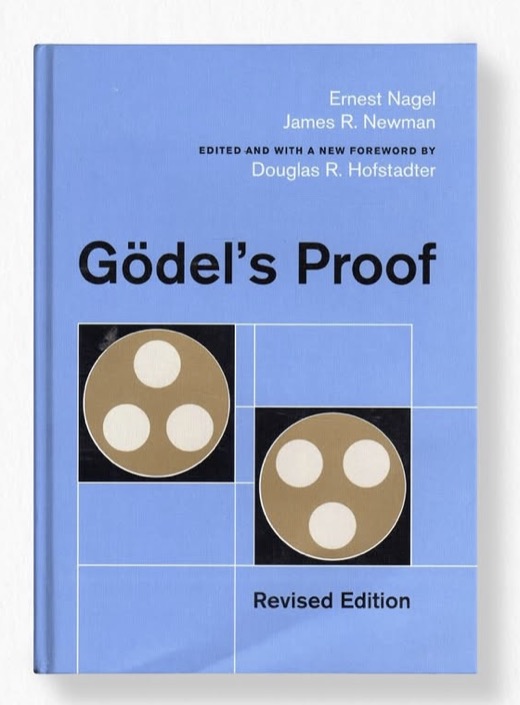
Gödel's Proof
Ernest Nagel & James R. Newman, 1958
This short, celebrated book explains, to readers without a background in advanced mathematics, one of the most significant and difficult results in twentieth-century logic: Kurt Gödel's 1931 incompleteness theorems. Nagel, a philosopher, and Newman, a mathematician and writer, walk through the historical context that made Gödel's work possible, including the crisis in the foundations of mathematics that emerged in the late nineteenth and early twentieth centuries, and the ambitious project (associated especially with Bertrand Russell and Alfred North Whitehead's Principia Mathematica) to place all of mathematics on a completely secure, self-contained logical foundation. Gödel's theorems shattered that ambition: he proved that in any formal system powerful enough to describe basic arithmetic, there will always exist true statements that cannot be proven within that system, and further, that such a system can never prove its own consistency from within itself. Nagel and Newman explain Gödel's ingenious method, which involves assigning unique numbers to logical statements and symbols ("Gödel numbering"), allowing statements about mathematics to be translated into statements within mathematics itself, enabling a formal system to make self-referential claims, conceptually related to the "This statement is false" paradox. The authors convey the logical structure and significance of the proof through careful, patient exposition rather than requiring readers to follow Gödel's full original formal apparatus. The book had an outsized influence on later thinkers, notably Douglas Hofstadter, who cites it as a direct inspiration for Gödel, Escher, Bach, and it remains one of the most accessible explanations of Gödel's theorems for a general audience.
Cover images are reproduced at thumbnail size to identify each edition