Introduction
Think back on a few supposedly civilization-ending technologies that arrived, caused some upheaval, but settled into the ordinary furniture of daily life. The automobile was going to destroy community. Television was going to lobotomize a generation. The internet was going to either liberate humanity or drown it in pornography, depending on whom you asked. And here we still are.
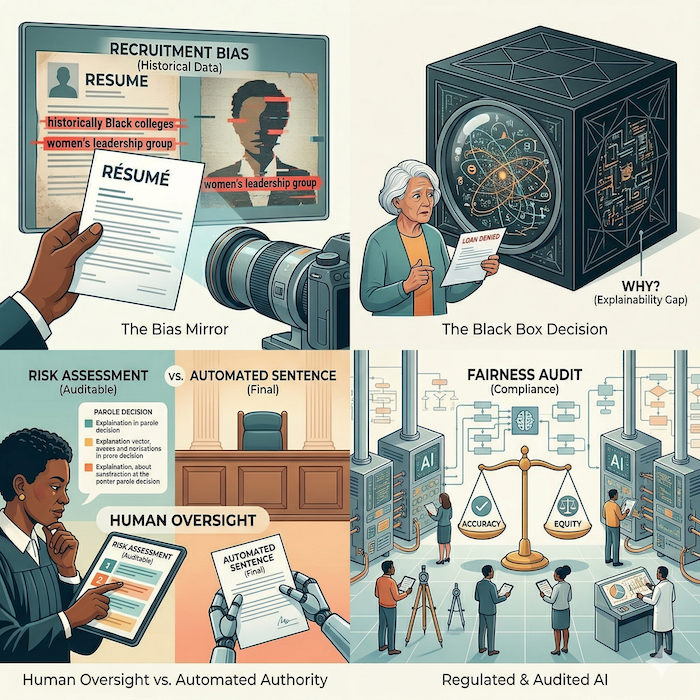
Is artificial intelligence any different? It has arrived in business workflows and public institutions not as a distant forecast but as a present fact: managers are already using it for hiring, customer service, legal review, financial analysis. Policy-makers are already choosing how to regulate systems that were hard to imagine only a decade ago. These are not abstract questions. They carry concrete consequences for employees, for consumers, for the texture of community life, and for competitive position. They affect real people.
At this early phase of AI's mass adoption, most public debate about artificial intelligence runs on moral instinct rather than ethical reasoning. People sense that something important is at stake, and they react with enthusiasm or suspicion or outright rejection. Those reactions, while understandable, are not sufficient guides for decision-making. Instinct tells us whether something feels right or wrong. Ethics asks the harder question: given real trade-offs, competing values, and uncertain consequences, what should we actually do?
The call to action here is to get ahead of controversy, to prevent calamity before it erupts, to put things in order before they exist. Otherwise we will end up the losers of another battle we blundered into.
"Thus it is that in war the victorious strategist only seeks battle after the victory has been won, whereas he who is destined to defeat first fights and afterwards looks for victory." Sun Tzu, The Art of War
Ten Ethical Controversies in AI
None of what follows is entirely new. The controversies AI generates have structural predecessors in earlier technologies. What changes is the speed, the scale, and the particular human anxieties that happen to be in the air at the moment.

Authenticity and Artificiality
One of the oldest and most persistent moral objections to any new creative technology is that its outputs feel inauthentic, not quite real, borrowed somehow, hollow. A portrait generated by an AI, an essay fabricated by a language model, a piece of music programmed without a human hand... each provokes something like suspicion, an instinct that what we are encountering is a simulation of the thing rather than the thing itself. But does authenticity matter intrinsically, or only when it serves some other value we care about? Because if it is only instrumental, that is, if we value authenticity because it usually signals effort, or craft, or genuine feeling, then we have to be honest that the argument is really about those things, and not about authenticity in the abstract.
Photography was once thought to be the end of painting. Recorded music was going to drive live performance obsolete. Calculators were going to end mathematical thinking. In each case the technology became normalized, and new, more nuanced definitions of what was authentic and what wasn't emerged in its wake. The ethical question is not whether AI outputs are authentic in some pure, philosophical sense; it is whether and when authenticity is actually a relevant criterion for the purpose at hand. And that is a question that has to be answered case by case, not in advance.
Creative Authorship
Closely tangled with authenticity is the question of credit. Who owns and who receives recognition for work produced with significant AI assistance. Our legal frameworks were built around the notion of a single human author, a romantic and not entirely accurate notion even before AI arrived. They are now straining to accommodate outputs that emerge from a kind of collaboration between human intention and machine generation that does not fit the old categories at all. There are real interests at stake here: property rights, which determine who can profit; and what we might call epistemic credit, which determines who receives recognition for insight and judgment. Neither of these questions has a settled answer, and probably won't for some time. What institutions can do is be honest about the fact that they are making choices with real consequences, rather than pretending the old frameworks still apply.
Labor Displacement and Productivity
When any technology multiplies productivity, societies face the same persistent dilemma: who captures the efficiency gains? This is not a new problem, rather, it has recurred in every significant economic transition since the industrial revolution, and arguably long before that. What makes AI different, and genuinely more uncomfortable, is that it reaches into cognitive labor rather than just physical work. It is one thing to automate a factory floor. It is another to automate the tasks of writers, analysts, paralegals, radiologists, coders. These people who spent years building expertise now face partial or outright displacement. The ethical question is not whether this is happening, because it is, but whether it is acceptable for the gains to flow primarily to those who own the technology while the costs are distributed broadly across the workforce. That is a policy question as much as an economic one, and the answer is not predetermined by the technology itself. It will be determined by choices that we are already making or will soon be called to make.
Professional Expertise
Advanced AI tools are beginning to perform tasks that once required licensed professionals, and to perform some of them very well indeed. Legal research, medical diagnosis, financial analysis, architectural design... in each of these domains AI systems can already match or exceed average human performance on specific tasks. The genuine dilemma this creates is that professional licensing systems serve two purposes that are in tension with each other: they protect the public from incompetent practitioners, and they protect practitioners from competition. AI forces a reckoning with which of those purposes is actually primary. Restricting AI to preserve professional structures benefits the professionals. Liberalizing access benefits consumers but may reduce accountability when things go wrong. Neither choice is without cost, and pretending otherwise is a form of intellectual dishonesty that does not serve anyone.
Knowledge Inequality
Access to advanced AI tools is not and will not be uniform. Premium systems cost money. The infrastructure to deploy them requires technical capacity that is not evenly distributed across organizations or communities. This creates what we might call epistemic stratification, or a world in which some people can afford enhanced cognitive capability and others cannot, with all the compounding advantages and disadvantages that implies. The debate here runs parallel to older arguments about private education, proprietary pharmaceuticals, or the advantages available to those who could afford high-frequency trading infrastructure. Should access to powerful tools that confer significant advantage be treated as a public good, like roads or clean water? Or as a private commodity, available to those who can pay? Both positions have defenders with serious arguments. What matters is that the choice is made consciously, as a choice, rather than allowed to happen by default.
Education and Academic Integrity
Institutions built around evaluating individual cognitive effort face a structural challenge when AI can perform that effort on demand. Prohibiting AI in educational settings is one response, and though this approach has a certain appealing simplicity, it carries its own costs. It may enforce a distinction between assisted and unassisted thinking that has never been as clean as we pretended, and it prepares students for a world that is already disappearing. The deeper ethical question is what education is actually for. If it is for producing students who can recall and reproduce knowledge without assistance, then AI is a threat to that project. If it is for developing judgment, intellectual curiosity, and the capacity to frame problems well (which should strike honest educators as the more important goal) then the relationship to AI is more nuanced and more interesting. Those two visions of education suggest very different institutional responses, and the choice between them cannot be postponed.
Information Asymmetry and Manipulation
AI's capacity to model human psychology and generate persuasive content at scale creates an ethical concern that extends well beyond the obvious territory of advertising. Political messaging, content moderation, and information curation are domains where AI dramatically amplifies the existing capacity for behavioral influence. The question is whether optimizing persuasion at population scale is compatible with meaningful individual autonomy. This problem first became acute with social media algorithms, but AI-generated content is faster, cheaper, more personalized, and more difficult to detect than anything that came before. We are not yet sure what the full consequences of that will be. We are, however, sure that the capacity exists and is being deployed.
Responsibility and Accountability
AI systems blur the traditional structures of accountability in ways that are genuinely novel and genuinely difficult. When an AI system gives harmful medical advice, approves a discriminatory loan, or produces a defamatory output, whom shall we blame? The developer who trained the model? The company that deployed it? The user who prompted it? The regulator who permitted it? This is a problem of distributed agency, where outcomes emerge from a chain of decisions made by many actors, none of which individually caused the harm in the way that traditional culpability assumes. We are going to need new frameworks for assigning responsibility, which means institutions and regulators are going to have to do some conceptual work that is hard and unfamiliar and cannot be done by looking at the old rules and hoping they stretch.
Human Dignity and Machine Capability
There is a recurring argument against deploying AI in certain domains that must not be dismissed as mere sentiment. The argument is that some activities should remain human-centered, not because machines cannot perform them competently, but because human participation in those activities is itself part of their meaning. Education, therapy, legal judgment, care work, for example, prove that being seen and responded to by another person has intrinsic value beyond the functional outcome. That the relationship is part of the service. This is not a sentimental claim. It is a philosophical one, and it deserves to be taken seriously in institutional decisions about where and how to deploy AI, rather than being waved away as resistance to progress.
Technological Restraint
The final controversy is perhaps the most fundamental, and the one that tends to make technologists most uncomfortable: just because a capability can be scaled, should it be? Modern societies have periodically chosen, after serious deliberation, to limit certain technologies on precautionary grounds. Examples include restrictions on particular applications of genetic editing, prohibitions on autonomous weapons or mass surveilance, regulatory slowing of pharmaceutical deployment while safety data accumulates. AI raises the same question. Some argue that deliberate restraint is essential to prevent irreversible harms. Others argue that restraint amounts to blocking beneficial innovation, with its own costs in lives and opportunities foregone. Both concerns are legitimate. The burden of proof is genuinely unclear. We need frameworks and we need them now.
A Framework for Analysis: Scarcity, Abundance, and the Distribution of Intelligence

Underneath all of the controversies above, there is a single structural question that keeps reasserting itself, the way a theme in music will resurface no matter how elaborate the variations become. The question is this: will the benefits of artificial intelligence remain concentrated in the hands of a relatively small number of powerful actors, or will they become genuinely widely distributed? This is the line between utopia and dystopia.
When intelligence tools are scarce, expensive, proprietary, and/or accessible only to well-resourced actors, they intensify the inequalities that already exist. Advantages compound. Gatekeeping intensifies. But when intelligence tools become abundant, affordable, widely accessible, and integrated into the ordinary infrastructure of daily life the way electricity or running water eventually became, something different happens. Expertise diffuses. Barriers come down.
History does not guarantee the abundance path. It does not even make it the more likely one. What history does suggest is that the outcome is not predetermined by the technology itself; it is determined by the choices that institutions and individuals make about how to deploy, regulate, and distribute access to that technology.
The table below maps the potential outcomes across both structural paths: scarcity vs. abundance.
| Topic / Ethical Controversy | Scarcity Path — Intelligence Concentrated | Abundance Path — Intelligence Distributed |
|---|---|---|
| Authenticity vs artificiality | Authentic work becomes an elite status signal | Authenticity shifts from "hand-made" to "human-directed" |
| Creative authorship | Gatekeepers enforce human-only legitimacy | Creativity becomes collaborative and hybrid |
| Labor displacement | Automation benefits owners of capital; widespread job precarity | Productivity gains reduce necessary labor; new economic models emerge |
| Professional expertise | Elite professions gain power by controlling advanced tools | Expertise becomes augmented rather than monopolized |
| Knowledge inequality | Premium AI creates informational aristocracies | Cognitive tools become universal infrastructure |
| Education | Institutions prohibit AI to preserve traditional evaluation | Education shifts toward judgment, curiosity, and problem framing |
| Academic integrity | AI use treated as cheating or intellectual fraud | Assistance becomes assumed; evaluation moves toward original thinking |
| Information asymmetry | Corporations and states dominate data resources | Open access reduces strategic informational advantages |
| Economic competition | Algorithmic advantage determines market winners | Market competition stabilizes as analytical capability spreads |
| Manipulation and persuasion | AI-powered persuasion concentrates in political and advertising firms | Widespread awareness and counter-tools reduce manipulation effectiveness |
| Behavioral influence | Attention economies intensify psychological exploitation | Personal AI agents help individuals defend against manipulation |
| Regulation | Regulatory capture by large technology firms | Public governance treats intelligence tools as infrastructure |
| Innovation incentives | Proprietary control dominates research ecosystems | Open innovation accelerates collective discovery |
| Intellectual property | Knowledge becomes increasingly privatized | Creation shifts toward shared knowledge ecosystems |
| Technological arms races | Nations compete to dominate AI capabilities militarily and economically | Shared capacity reduces strategic asymmetries |
| Autonomous decision systems | Decision power concentrates in opaque systems | Decision support tools empower individuals and local institutions |
| Responsibility and accountability | Complex systems obscure who is responsible for outcomes | Transparency tools make system behavior understandable and auditable |
| Human dignity | Humans compete against machines in domains where machines excel | Machines handle optimization while humans focus on meaning-making |
| Creative identity | Artists struggle to justify the value of human creation | Human creativity becomes more exploratory and expressive |
| Cognitive hierarchy | Intelligence becomes a stratified commodity | Cognitive capacity becomes broadly augmented across society |
| Technological dependence | Reliance on centralized systems creates systemic vulnerability | Distributed intelligence reduces reliance on singular institutions |
| Security and cybercrime | Advanced AI tools enable sophisticated fraud and exploitation | Defensive systems evolve simultaneously, reducing asymmetry |
| Data ownership | Personal data becomes a highly valuable corporate asset | Individuals control personal data through decentralized systems |
| Global inequality | Technologically advanced regions dominate economically and politically | AI tools reduce barriers to development worldwide |
| Scientific discovery | Breakthroughs cluster around well-funded institutions | Collaborative networks accelerate discovery globally |
| Economic structure | Wealth concentrates around owners of computational infrastructure | Economic value shifts toward services, creativity, and human experience |
| Work identity | Employment remains the primary source of identity and status | Identity shifts toward projects, relationships, and pursuits beyond economic survival |
| Clever advantage | Strategic manipulation of systems becomes the dominant path to success | Strategic advantage declines as analytical capability becomes universal |
| System gaming | Optimization incentives create endless loophole exploitation | Fewer gains exist from exploiting systems once capabilities are universal |
| Social trust | Suspicion of artificial outputs erodes trust in institutions | Transparency tools allow verification and restore confidence |
| Cultural values | Society divides into camps that morally reject or embrace AI | Cultural norms stabilize around pragmatic coexistence |
| Moralization of technology | Technology debates become identity conflicts | Technology is treated primarily as a governance and design problem |
| Technological restraint | Fear of concentrated power leads to calls for bans or strict limits | Broad distribution reduces perceived existential threat |
| Political power | AI enhances state surveillance and central authority | AI tools empower civic participation and decentralized governance |
| Human flourishing | Progress measured primarily through productivity and efficiency | Flourishing includes creativity, leisure, exploration, and social connection |
What actual variable determines whether a given controversy resolves toward conflict or toward normalization? It is the structural one: does cognitive capability remain scarce, or does it become genuinely abundant? The same tool, deployed differently, produces different worlds. That is a hopeful observation because it means the outcome is not fixed. It is being decided, right now, by people making choices about deployment, access, and governance.
Nine Philosophical Lenses
Here are nine thinkers whose ideas, years ago, foreshoadowed today's AI tensions. Each of them identified a structural pattern that tends to recur wherever powerful tools intersect with human institutions and human incentives. None of them were writing about AI, but all of them were writing about something that turns out to apply directly to it.
Charles Goodhart · EconomicsGoodhart's Law: When Metrics Replace Goals
When a measure becomes a target, it ceases to be a good measure. Once an institution begins optimizing for a proxy of its actual goal, behavior quietly shifts toward satisfying the proxy, whereby the original goal begins to recede.
AI systems are extraordinarily powerful optimizers, which makes this law directly and uncomfortably relevant. A content system optimizing for engagement will amplify outrage, because outrage reliably drives clicks. The question organizations need to ask is not merely what is this system maximizing? but is that actually what we want?
Marshall McLuhan · Media TheoryThe Medium is the Message
Technologies do not merely carry content. They reshape how people think, perceive, and relate to one another. The effects of a medium run deeper than what it transmits, and they accumulate over time in ways that are difficult to see from inside them.
AI is already changing cognitive habits in ways we are only beginning to observe. People are asking rather than searching, delegating rather than deliberating, summarizing rather than reading. These are not trivial shifts. Organizations that deploy AI without accounting for how it changes the way their people think — not just what they produce — may find they have optimized outputs while quietly eroding the institutional judgment that makes those outputs meaningful.
Michael Polanyi · Philosophy of ScienceTacit Knowledge: What Cannot Be Automated
Human expertise is largely tacit, as we know far more than we can articulate. The deepest professional competence consists of contextual judgment, embodied experience, and intuitions so well-integrated that they can never be fully written down or transferred.
This is both a limit on AI and a guide to its deployment. AI excels at explicit, codifiable tasks. It struggles with context-sensitive judgment, ethical nuance, and knowledge that can only be acquired by having actually lived through something. An AI system can generate a differential diagnosis. It cannot feel the hesitation in a patient's voice.
Martin Heidegger · PhilosophyEnframing: Technology as a Way of Seeing
Modern technology encourages a particular way of encountering the world, one that frames everything, including human beings, as resources to be optimized and managed. Heidegger called this enframing, and his concern was that it would gradually narrow what we are capable of experiencing.
When wellness apps score sleep quality, productivity tools score focus, and recommendation engines predict preferences before we have fully formed them ourselves, life begins to feel like a performance to be optimized rather than an experience to be lived. This is a practical concern, not just a philosophical one, and organizations building AI systems that shape how people understand themselves carry real responsibility for the interpretive frameworks those systems impose.
Hannah Arendt · Political PhilosophyLabor, Work, and Action
Arendt distinguished three modes of human activity: Labor — the repetitive work of biological survival; Work — the making of durable things that outlast us; and Action — meaningful human interaction, speech, judgment, and participation in the life we share with others.
AI is well-positioned to absorb labor, and much of what we call work. But what it cannot replace is action in Arendt's sense: genuine conversation, moral judgment, the creation of meaning through relationship, and presence. As AI takes over more of the former, the question for institutions is not what can AI do? but what do we want to insist that humans remain responsible for?
Ivan Illich · Social CriticismConvivial Tools: Empowerment vs. Dependency
Tools exist on a spectrum. At one end are convivial tools that enhance human capability, remain understandable to the people who use them, and do not create dependency. At the other end are counterproductive tools that accumulate expertise in institutions, reduce the capacity of individuals, and create systems that people cannot function without.
A personal AI assistant that helps someone think through a problem and explains its reasoning is, in Illich's terms, a convivial tool. An opaque algorithmic system making consequential decisions about creditworthiness or parole eligibility, without interpretable justification, is its opposite. Organizations choosing between these orientations are making a more fundamental choice than they may realize.
Friedrich Hayek · EconomicsThe Knowledge Problem: Limits of Centralization
Knowledge in society is irreducibly distributed. It exists in the particular, the local, the contextual experience of individuals. No central system, however sophisticated, can fully aggregate it. This was Hayek's foundational argument against planned economies, and it applies with equal force to any attempt to centralize intelligence.
AI systems are trained on distributed human knowledge, but they do not capture all of it, particularly not the kind that is recent, local, tacit, or genuinely contested. Organizations that treat AI output as a substitute for the distributed judgment of people close to a problem will systematically miss what the system cannot know. AI is most valuable when it informs human judgment rather than replacing it.
Jean Baudrillard · PhilosophySimulation: When Representation Replaces Reality
Modern societies, Baudrillard argued, have increasingly come to inhabit representations of reality rather than reality itself. And the troubling thing is that the distinction between the two can collapse so gradually that people do not notice it happening.
AI dramatically accelerates this tendency. Chatbots can seem emotionally responsive. Synthetic text can read as more authoritative than careful analysis. Generated images can appear more coherent than photographs. The concern is not that people are easily fooled but that, at scale and over time, the pervasive availability of convincing simulation quietly shifts what we treat as evidence, as relationship, and as experience. The difference between AI that helps represent the world accurately and AI that produces compelling representations regardless of accuracy is a difference that matters enormously.
Herbert Simon · Cognitive ScienceAttention Economics: Scarcity Has Shifted
A wealth of information creates a poverty of attention. When information is abundant, the genuinely scarce resource is not knowledge but the human capacity to evaluate it, discriminate among it, and act on it wisely.
AI dramatically increases the volume of generated content, such as summaries, analyses, images, responses, reports; it does so at a speed and scale that human attention cannot match. The bottleneck is no longer access to information. It is the ability to tell what deserves attention from what does not. In an AI-rich environment, the most valuable organizational capabilities will be discernment and the capacity to ask the right questions. Mistaking information access for insight is a confusion that will be expensive to correct.
Knowledge, Power, and Historical Precedent

My objection is this: knowledge stratification is ancient and persistent, and it has survived every previous technology that was supposed to democratize it. Intelligence services, technocratic elites, professional monopolies, literate classes... they have always held informational advantages over the populations beneath them. The printing press was supposed to change all that. So was the telegraph. So was the internet, and we all know how that turned out. AI will be different unless we prevent trouble before it arises, putting things in order before they exist.
| Era | Gatekeeping Technology | Who Held Advantage |
|---|---|---|
| Oral societies | Memory and ceremony | Ritual elites |
| Manuscript culture | Literacy | Clergy and scholars |
| Printing press | Publishing access | Literate middle classes |
| Industrial age | Technical education | Engineers and bureaucrats |
| Internet age | Network and data access | Platform owners and data holders |
In oral societies, ritual elites held advantage through memory and ceremonial knowledge that was not written down because writing did not yet exist. The manuscript era concentrated power among those who could read, which meant primarily the clergy and the scholars they trained. The printing press destabilized that arrangement profoundly; while it did not eliminate hierarchy, it did shift its architecture, and the Reformation and the emergence of modern democracy were among the consequences. Industrial education systems created new technical elites to serve industrial economies. The internet initially distributed access to information with remarkable generosity, then reconcentrated power around the platform owners who controlled the channels and the data holders who controlled what moved through them. The pattern is not that stratification persists unchanged. It is that stratification persists while its basis evolves, and the evolution matters enormously for the people living through it.
What makes AI unusual in this historical sequence is that it potentially automates reasoning itself, not merely physical labor, not merely communication, not merely information storage, but the actual work of thinking. Calculators eliminated arithmetic advantages. GPS eliminated navigation advantages. Translation tools steadily reduce language advantages. Each time a cognitive skill is automated and made widely available, the specific hierarchy it sustained erodes. New hierarchies tend to emerge elsewhere, which is why the AI skeptic is not entirely wrong. But the specific hierarchy erodes, and that erosion has real effects on real people. The genuinely open question is whether AI erodes cognitive hierarchies broadly, or merely displaces them to a new location where the same people, or their heirs, are likely to end up in control.
My expectation is that AI will produce three simultaneous effects. Some existing expertise will become less valuable as routine cognitive tasks are automated. New expertise will emerge around system design, interpretation, and governance. And power will concentrate around whoever controls the infrastructure: the compute, the data, and the institutional access. Knowledge stratification is unlikely to disappear. But its basis may shift from who knows things to who controls systems that generate knowledge, and that is a different structure of power, with different implications for regulation, for education, for antitrust policy, and for the design decisions being made right now by organizations that are only beginning to understand what they are choosing.
A useful question for practitioners is not whether AI will change knowledge hierarchies, for it will, but whether those changes will concentrate cognitive leverage further or distribute it more broadly. History suggests that outcome is not predetermined, that it has always depended on institutional choices: open versus proprietary, regulated versus unregulated, accessible versus restricted. Those choices are being made right now and it is not a burden to be anxious about. It is a remarkable opportunity, that is, if one approaches it with sufficient honesty, and sufficient care.
About This Essay
An analysis of the moral and ethical dimensions of artificial intelligence for business owners, managers, and community policy-makers considering AI adoption in their workflows and institutions.
Topics Covered
- Ten core AI controversies
- Scarcity & abundance framework
- Nine philosophical lenses
- Knowledge, power, and historical precedent