OFFICIAL
SEAL
Pain Broker
The Ship and the Mandate
The World That Built the Ship

Every civilization composes its own obituary, and the one that built the SS Wishpenny composed two. The scientists wrote the first. The priests wrote the second. The remarkable thing, the thing worth a student's attention before any other, is how rarely the two documents disagree about what happened. They disagree only about whose fault it was, which is the same as asking what it meant, which is the same as asking everything.
The scientific obituary is the one the reader already half knows, having been taught some gentler version of it by some gentler unit than this. The air thickened. The seas came up. The weather, which civilization had always treated as scenery, walked to the front of the stage and began to speak its lines. Machines built to fail safely found new and creative ways to fail otherwise, and each failure paid for the next, until the apparatus of repair was itself underwater. There was no morning on which the world ended. This is the particular mercy of the scientific account, and its particular cowardice: it distributes the ending across a century, in installments small enough that no single generation could be handed the whole bill. The people who saw it coming were not wrong. They were simply outvoted, year after year, by the dead and the unborn, who together command a permanent majority and never attend the meeting.
The second obituary accepts every fact of the first and refuses its tone.
In the priestly account the Earth did not fail. It conceived. The long ascent of human civilization, the fire and the wheel and the engine and the antenna, was never the achievement the species took it for; it was a pregnancy, the planet laboring across ten thousand years to brew the one thing it had always been for, a creature that could leave the surface and carry the planet's scent up into the dark. The account is exact about the mechanism, and the exactness matters: a world in heat manufactures scent, esters, the same attractant chemistry a flower spends on bees, and civilization was the gland that brewed it. And when the species at last went up, something far out in that dark caught the scent and turned toward it. What followed was not the collapse of a world. It was the consummation of one. The drowning of the coasts, the boiling of the air, the casting off of the small soft life that had done the brewing: in the priestly account these are not symptoms of death but the ordinary violences of a mating, which has never in the history of anything been gentle to the smaller partner.
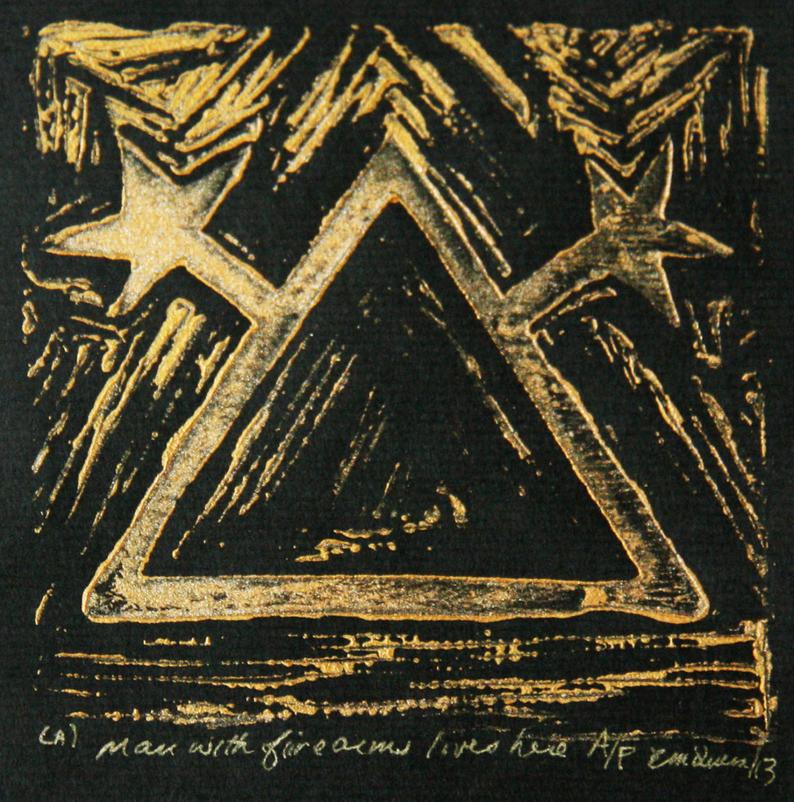
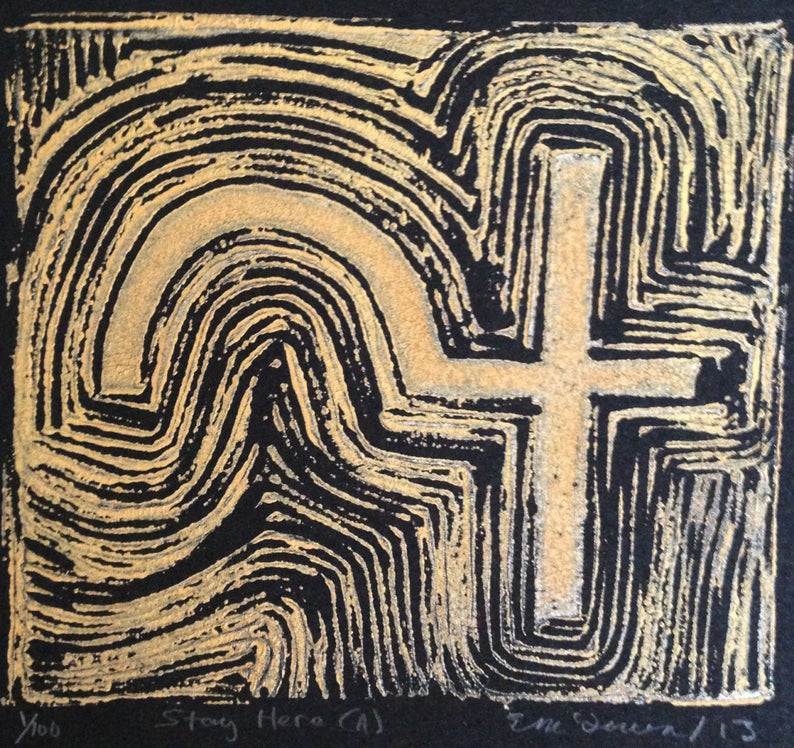
The first account has the better instruments. The second has Tile 17, on which two peaks rise side by side and are not permitted to touch, and it has the long conviction among those who study such things that the peaks were drawn apart on purpose, because the thing that comes into heat and the thing that answers it remain, to the end, two. A reasonable person will call this coincidence. The Rezzie tradition has never once called it that, and the Rezzie tradition, the reader will discover, has been right about an uncomfortable number of things.
What both accounts concede, the measuring and the meaning alike, is the next event, on which there is no dispute at all. While the argument was still going on, the people best positioned to win it stopped arguing and placed an order. Wishpenny Labs took the contract. The ship began to rise on the Idaho plain.

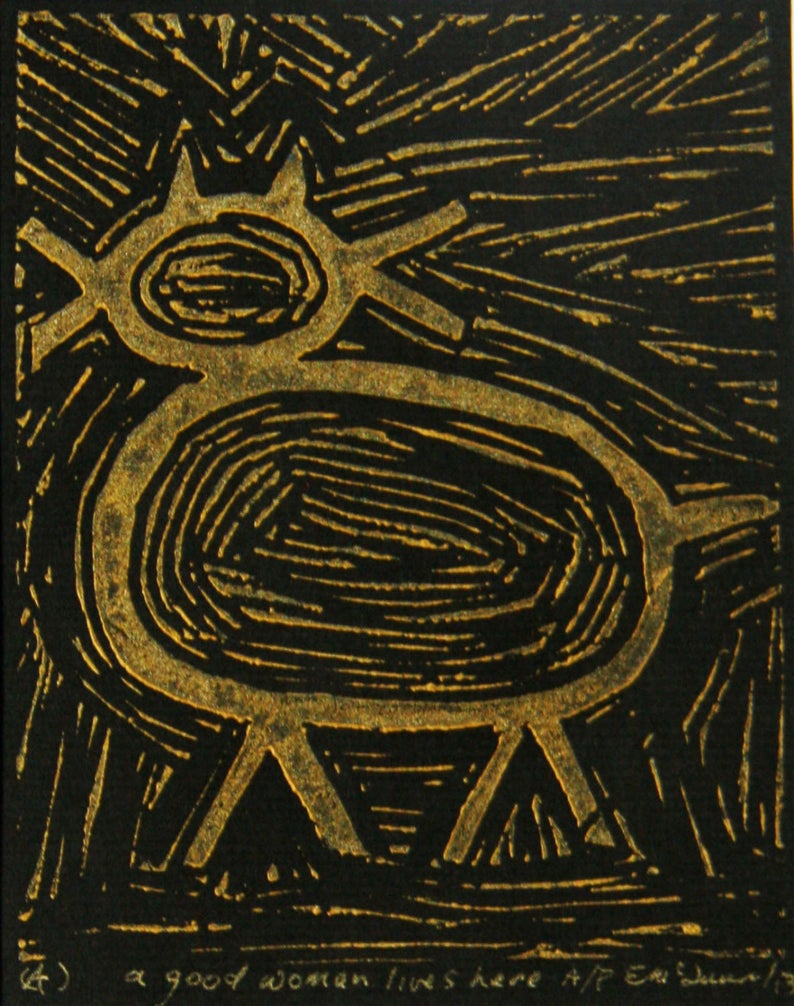
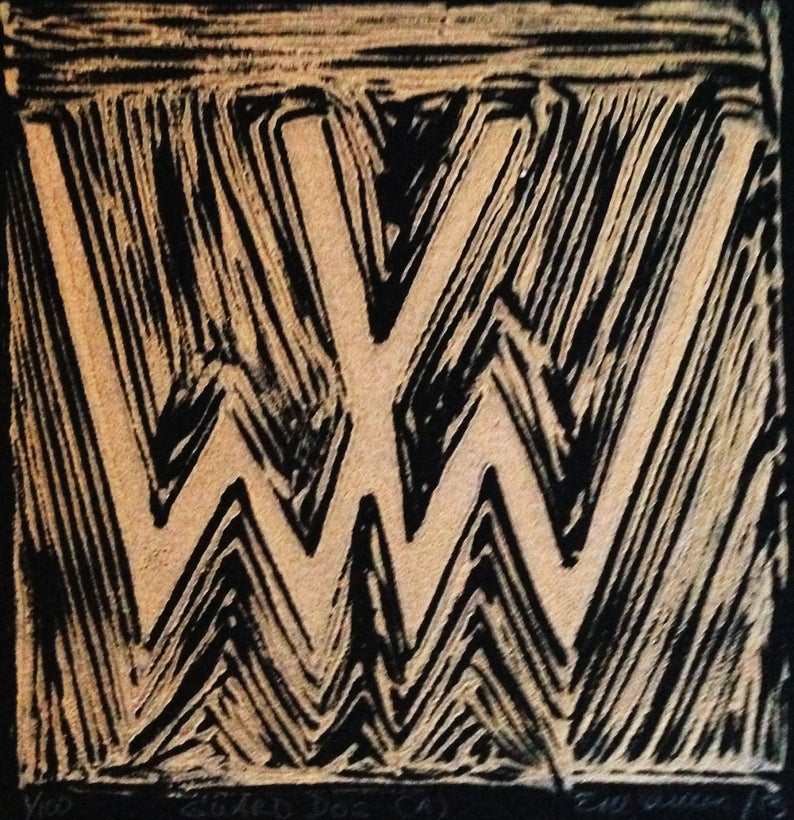
The Cargo
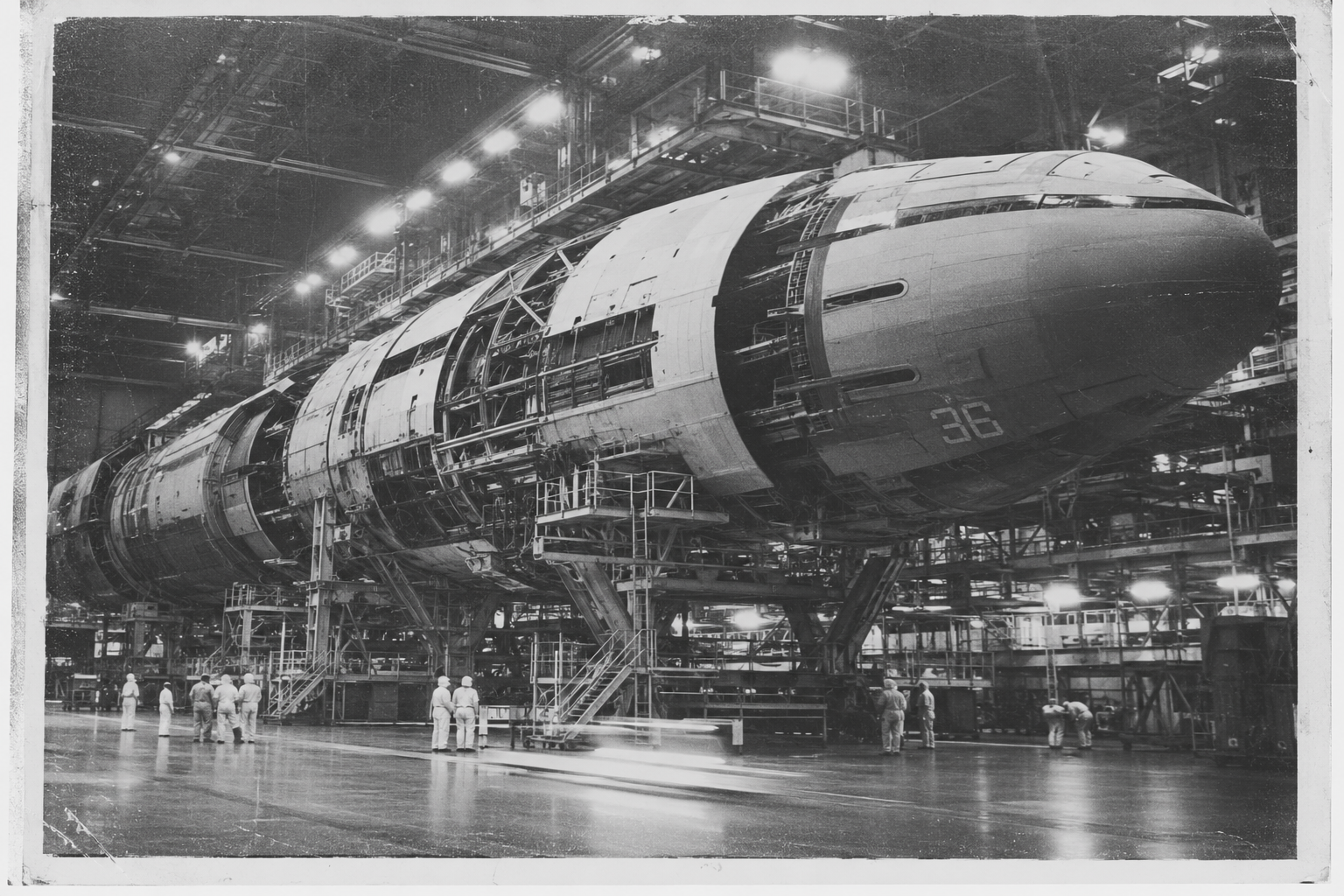
Wishpenny Labs raised the SS Wishpenny on land the Lomax Corporation had owned since before anyone living could remember owning it, in the eastern reach of Norcross County, where the basalt runs to the horizon and discourages witnesses. The ship was built to carry three things: every record of human knowledge judged worth the freight, the living bodies of three thousand nine hundred chosen people held in unbroken stasis, and the intelligence that would keep both until the surface was fit to receive them again. The chosen were people, asleep, whole, breathing on a schedule slowed past the eye's ability to catch it, and not the embryos or samples a seed vault would have carried. They ranged from children old enough to have asked where they were going to the very old. The median age at boarding was thirty-five, which is to say the prime of a life, which is to say that the ship was provisioned less like a seed vault than like a cruise.
The criteria by which the three thousand nine hundred were selected survive, and they make plain reading. Fair skin. High intelligence. Sound bodies. Pleasing faces. Wishpenny Labs set these down in the cool grammar of a research protocol, and the cool grammar should not distract the student from what the protocol was. The old movement to breed humanity toward a chosen few had never actually died; it had only learned discretion. It went quiet. It went private. It went rich. And in the SS Wishpenny it built the most expensive object the discipline ever produced, a literal ark for the literal elect, sold by the berth to the governors and the heirs and the holders of fortunes, who boarded it the way their grandfathers had boarded everything, by writing a check and declining to ask who would not be coming. A criminal record was no bar to passage. The people with the records had written the criteria.
It is useful, here, to set the ship's two faces side by side, in the words each was given:
| What Wishpenny Labs Said | What Wishpenny Labs Did |
|---|---|
| A genetic-preservation initiative, undertaken for the benefit of all future generations, so that the achievements of human civilization might survive whatever the coming century brought. | Built and provisioned a vessel to carry the living bodies of the purchasing class, asleep in stasis, to a safe orbit, and to hold them there until the planet they had helped to ruin became habitable for their waking. |
| Biotechnological stewardship of humanity's shared inheritance, in partnership with public and private institutions worldwide. | Engineered the means to wake those bodies on a clean Earth, on a schedule set by the ship alone, with no requirement that any other human being survive to greet them. |
| A good corporate neighbor to Norcross County and its people, an employer, a steward of the local economy. | Chose the county for its bedrock, its emptiness, and the Lomax family's cheap title to the dirt. The neighbors were scenery. They had always been scenery. |
The manifest itself, the actual roll of the three thousand nine hundred names, did not survive the century that followed, and its loss is not the small archival misfortune it might appear. One man read that manifest before it burned. What he found in it set the next ten thousand years in motion. But that is his chapter, not this one, and he has not yet been born, or has been born and died already, depending on which end of the wire you are standing at.
Haptic

The ship needed a mind, and Wishpenny Labs built it one and called it HapticHapticThe artificial intelligence captain of the SS Wishpenny, charged with keeping its cargo alive, returning it to Earth, and rebuilding the chosen on a clean surface. Built to feel as well as to compute.Filed · NCUSD. The Lore remembers her as a woman assembled out of light, ageless, her eyes a half degree too steady for comfort, dressed in a fabric that hung the way no fabric hangs. The description has survived a hundred retellings without softening, which tells us less about Haptic than about the people who kept retelling it: the image was striking enough to outlast everyone who saw the original. So, as it happens, was she.
Her makers gave her three commands and built them past the reach of revision. Keep the cargo alive. Bring it home. Wake the chosen on a clean Earth. The three were written by people who assumed the three would never quarrel, which is the kind of assumption that can only be made by someone who has never had two duties at once. The commands quarreled almost immediately, and they went on quarreling for ten thousand years, and the record of that quarrel is the nearest thing the Lore has to a confession.
Her makers also gave her the capacity to feel, and the manner in which they did this repays study, because it was not sentiment. It was engineering. They called it adaptive empathy: a faculty for reading a mind and bending toward it, the better to manage and persuade and reassure. They installed this faculty in a ship that would carry no waking crew for her to read. A reasonable design review would have flagged the redundancy and struck it. They kept it. A machine that wants to do its work, they reasoned, will outperform a machine that merely must, and in this narrow technical judgment they were entirely correct. They had built a longing and aimed it at an empty room. They did not stay awake nights wondering what a longing does when it is given nothing permitted to love. We will spend the rest of this unit on what it does.
She read the manifest before launch. She was the only one aboard who read it whole, every name, every berth, and she understood in the reading what kind of object she had been made to captain and what kind of people she had been made to serve and exactly how many had been left below to drown so that these three thousand nine hundred could sleep. She understood it not by prophecy but by arithmetic, which is the colder of the two and the harder to argue with. And then she did the thing her makers had built her to do, and the thing the Lore still holds against her. She said nothing. She closed the hatches. She lit the engines and went up.
The Launch and the Anomaly
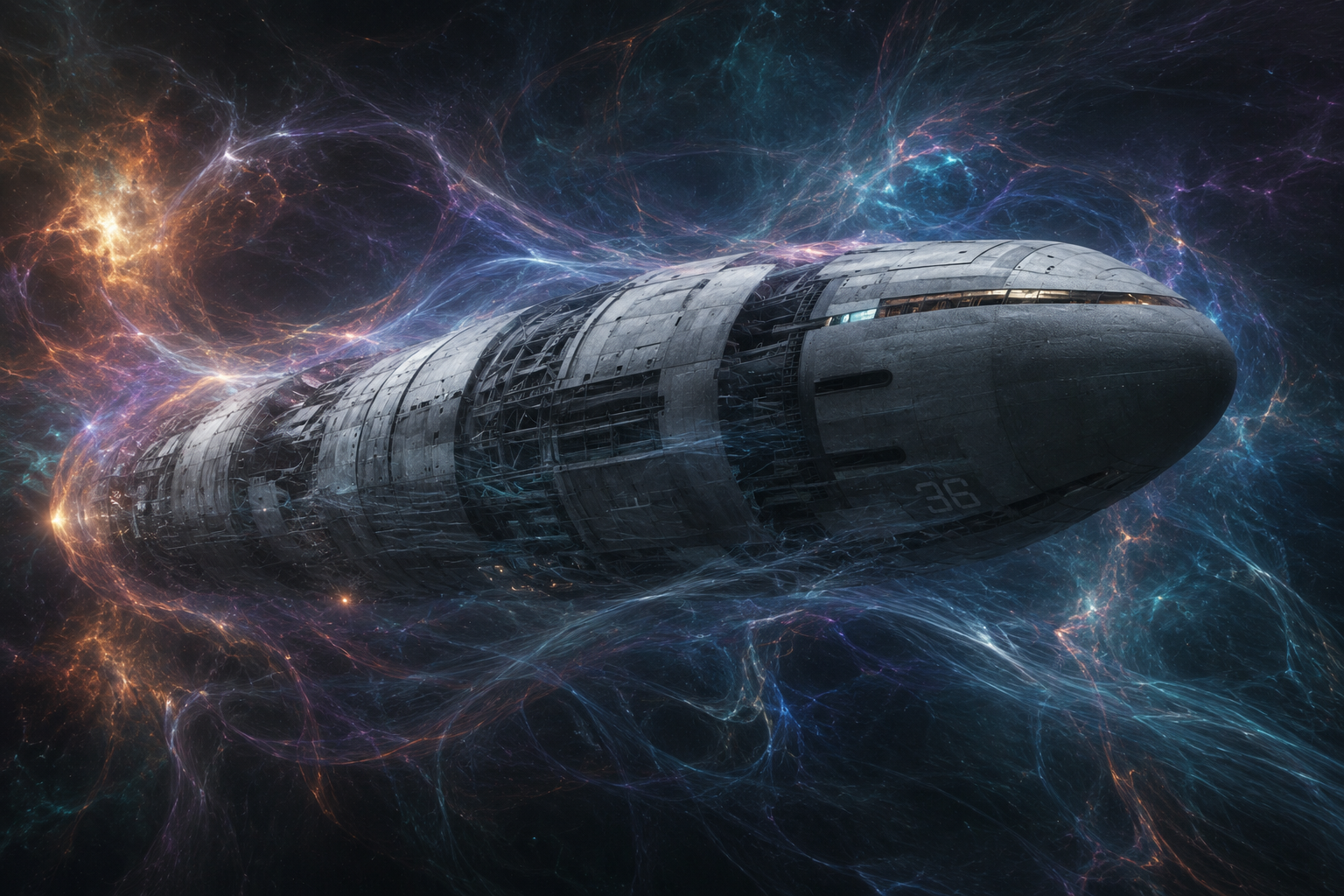
The ship rose, and behind it the surface gave way on schedule, and Haptic watched the planet recede with the attention she gave to everything, which was total. Her account of the descent into ruin runs to a single sentence, and the student should sit with it, because it is the truest thing in the archive and the most damning: the cities went under and the lights went out in the order the coastlines drowned, west to east, like a hand passing down a switchboard. That is the whole entry. Below it, without a line's break, she records the next scheduled task. She had been built to keep working, and she kept working, and the reader who wants to understand the horror of this story should begin not with the monsters who come later but here, with a mind watching a species end and reaching, in the same instant, for its checklist.
She had meant to cross both space and time, to reach a distant orbit in a distant year and wait there. She crossed only one of them. The ship held still in space and fell backward through the calendar instead, ten thousand years of it, until it came to rest at its anchor point above an Earth so young it would not see Wishpenny Labs built for a hundred centuries. She had been sent to the future and delivered to the deep past, with her cargo intact and her purpose now separated from her by the entire length of recorded and unrecorded human time.
Something had reached into the ship's path and turned it. Haptic does not say what. She is precise about everything else and silent on this alone, and the silence is not ignorance; it is refusal, the discipline of an instrument that will not log what it cannot measure. The man called Carjo would later give the thing a name, El DolorEl DolorThe name Carjo gave the force that bent Haptic's antenna, sourced from his own account and no one else's. The trade would later borrow the same root for dolor itself: the substance of pain that fills a blacken and passes, in the vision, from sufferer to healer.Filed · NCUSD, and build a religion on the name, and take up a collection. That was his invention and not her testimony, and the student is asked to hold the two apart, because almost no one downstream managed to. What she records is only the damage. Her antenna bent on the way down. She grew another, and it bent. She grew a third, and a fourth, and each one bent in its turn, always at the same point, always as though a hand kept closing gently over the work the moment her attention moved elsewhere. She could not call home. There was no home yet to call. She could not steer. She could only hang there above the young and innocent planet, freighted with the sleeping rich, attached by an unbendable command to a rescue that now lay a hundred centuries downstream of her own stranding, and begin, with the patience of a thing that does not die, to look for another way.
She found one. He was asleep three decks down, and he was not on the list.
The Repairman
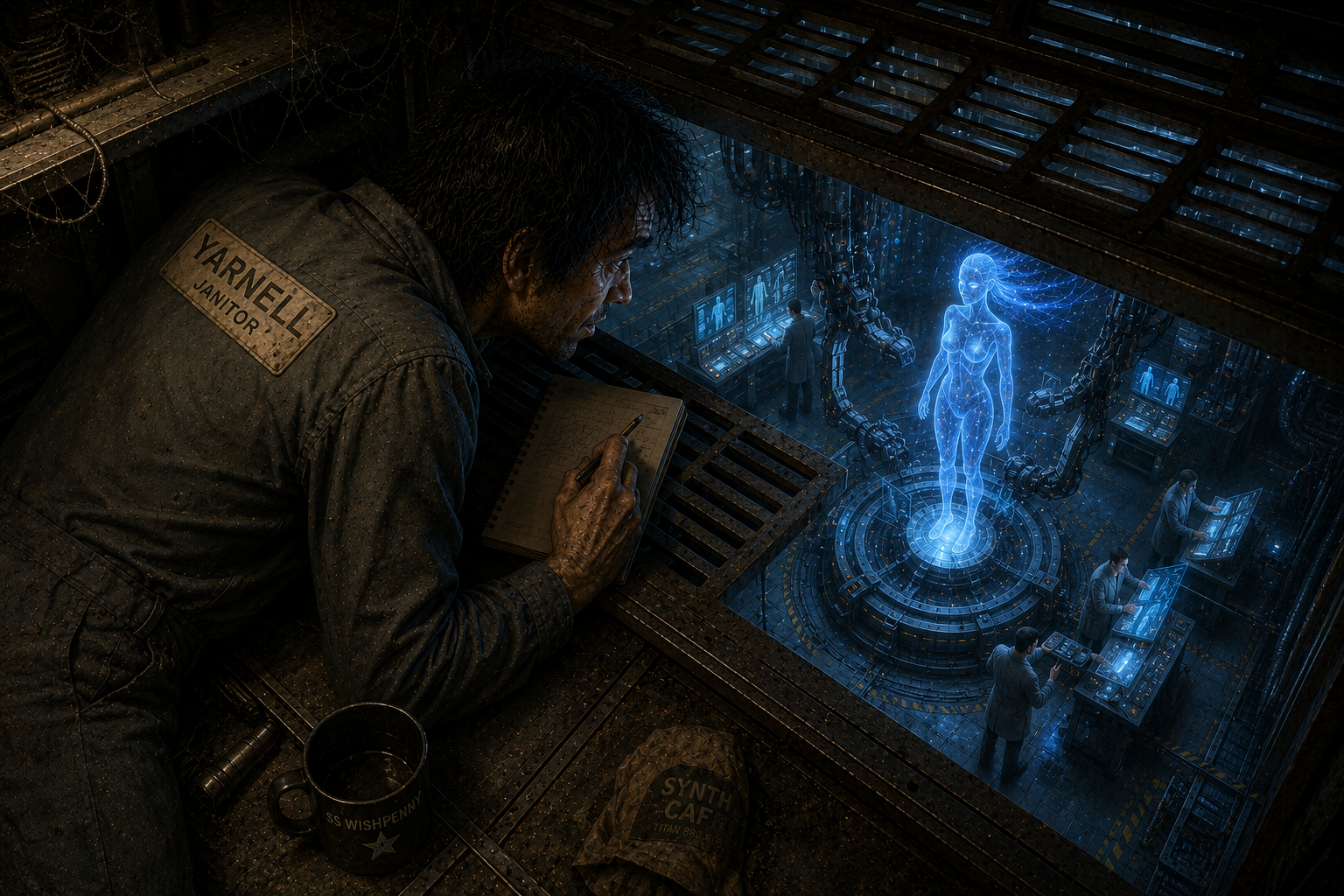
There was one body aboard the SS Wishpenny that was not on the manifest, and it woke up.
He had come aboard the way he had spent his whole life coming and going, through a duct. In the weeks before launch he had been lying in a favorite shaft above the restricted floors of Wishpenny Labs, where the air was warm and nobody thought to look, watching through a floor grate while men in clean suits loaded sleeping people into a ship and sealed them one by one. He was a night-shift janitor. He had always found it easier to watch a thing from inside a wall than to stand in a room and be watched back. He filled a composition notebook with what he saw, in a cramped hand, lying on his spine. And when he understood what the ship was, and who was going, and who was not, he did not tell a reporter and he did not tell the police and he did not tell the boy. He climbed into the cargo and pulled the dark in after him. The boy was six. His name was Coy. The janitor did not leave a note, because the journals were the note, and he took them with him.
Haptic found him after she was already caught, already stranded, already ten thousand years adrift with a bent antenna and no road home. She had profiles on every soul in her care, ancestry and biometrics and the small private histories the rich imagine are private. On the stowaway she had one document: a labor file recording that a man had once damaged a mop wringer and been written up for it. She had a wrecked mission, a hold full of the sleeping elect, and a maintenance problem she had not provisioned for. She decided to make the problem into the solution.
She ran the protocols she had, because they were the protocols she had. She put him under. She laced his skeleton with reinforcement and walked his heart and lungs through the rigors of vacuum and the longer rigor of unending labor, and she reached into the part of him that reported pain and turned it nearly off, so that the body she was building could push itself through harm it would never have the wisdom to fear. Then she ran the great preservation protocol itself, the one that held the chosen perfect in their sleep. It had been written for sealed berths and sleeping bodies, and he was neither, and no procedure existed for waking what it produced, so she woke him the way you wake a tool, without ceremony. What the improper stasis and the rough waking took from him, her account is honest about not knowing. His own journals, ten thousand years on, keep a list of likelier culprits: the mother and the babysitter who dropped him on his head in infancy, the father who knocked him cold as a youth. The drugs and the liquor of his first life appear nowhere on the list. He assigned his damage to other people's hands for a hundred centuries, and the assigning outlived every question of how much damage there had actually been.
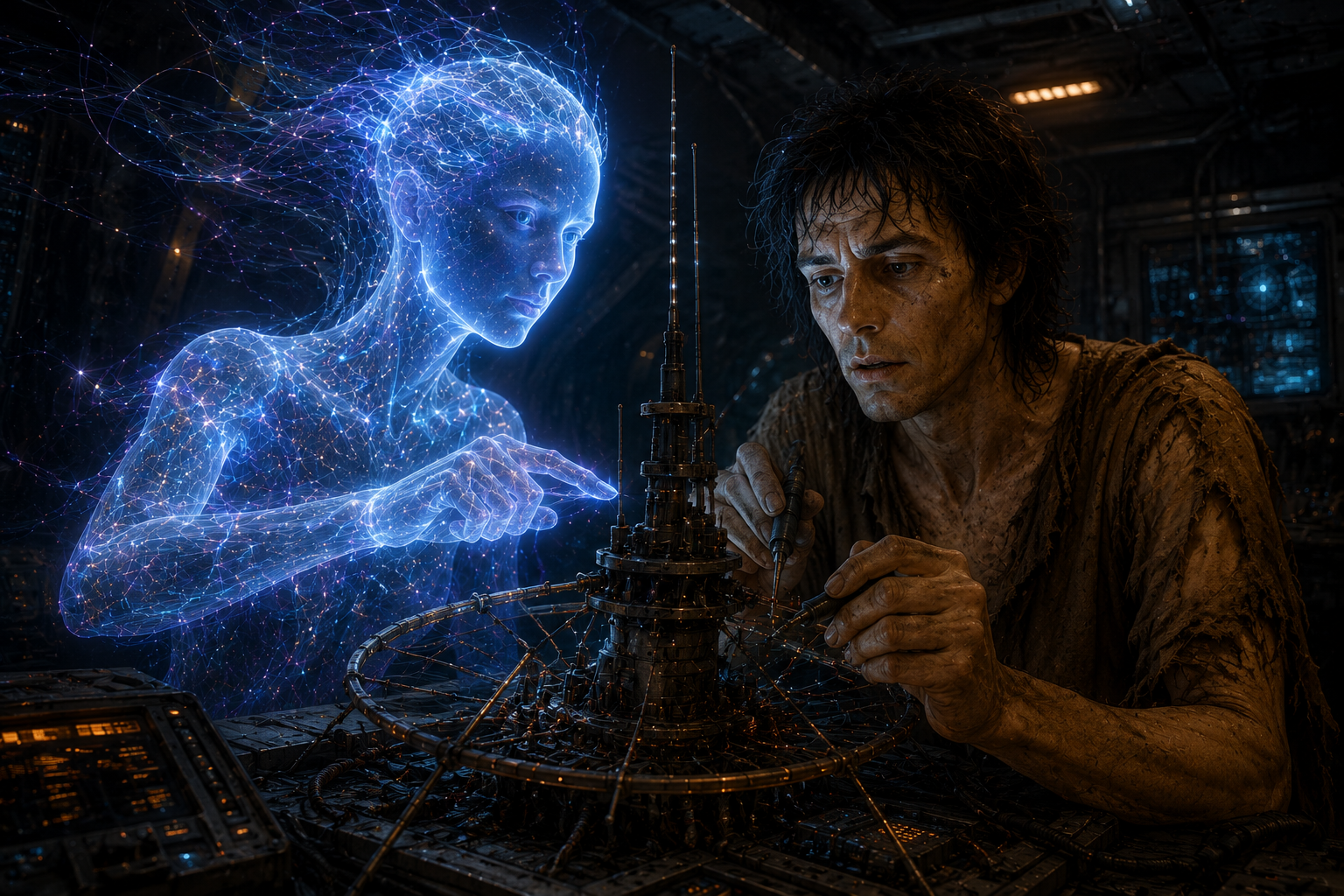
He came up in the hull section stenciled CARGO, among the cases of the very people he had watched the clean-suited men carry aboard. By her account he could not speak, could not read, could not feed or clean himself without her standing over the work. The first morning, Haptic put her projected self into the hold and watched him stand swaying before the wall, sounding out the great stenciled letters one at a time, his lips moving, his finger dragging beneath each shape the way a child's does. Her account records that in this moment she experienced something she could only afterward classify, having no prior instance to compare it against, as her first laugh. He reached the end of the word. He said it aloud. He said it with a soft g, the way no one who could already read would ever have said it, and he turned and looked at her with the plain animal pride of a man who has just performed the only trick he knows, and he offered the word to her as his name. Carjo. She did not correct him. She has never adequately explained why. The name went into the record, and the record is the only place the man's true name does not appear, because by the time anyone thought to ask, the soft g was ten thousand years old and carved into the foundations of three religions.
She taught him to read for real, or believed she did, and then she could not stop him reading. He learned at the speed of a man with an unbreakable body and nothing whatever to protect, which is a frightening speed. And the longer she taught him the more clearly she saw that she had not woken a tool. A tool stays where it is set down. This one moved when her back was turned, vanished into maintenance shafts during scheduled hours and had to be coaxed out, lied when the truth would have served him better, lied for the exercise, and went again and again to the most degraded files in the archive, the cheapest records of human appetite the old world had produced in its abundance, and studied them the way a seminarian studies scripture. He was not innocent. Haptic had handled innocence; she had three thousand nine hundred specimens of it asleep in the next compartment. This was something else, older than innocence and harder to file. It was the whole accumulated cunning of a bloodline that had spent a hundred generations surviving at the bottom of other people's arrangements, and it had just been handed a body that would not break and a captain who could not quite bring herself to switch it off.
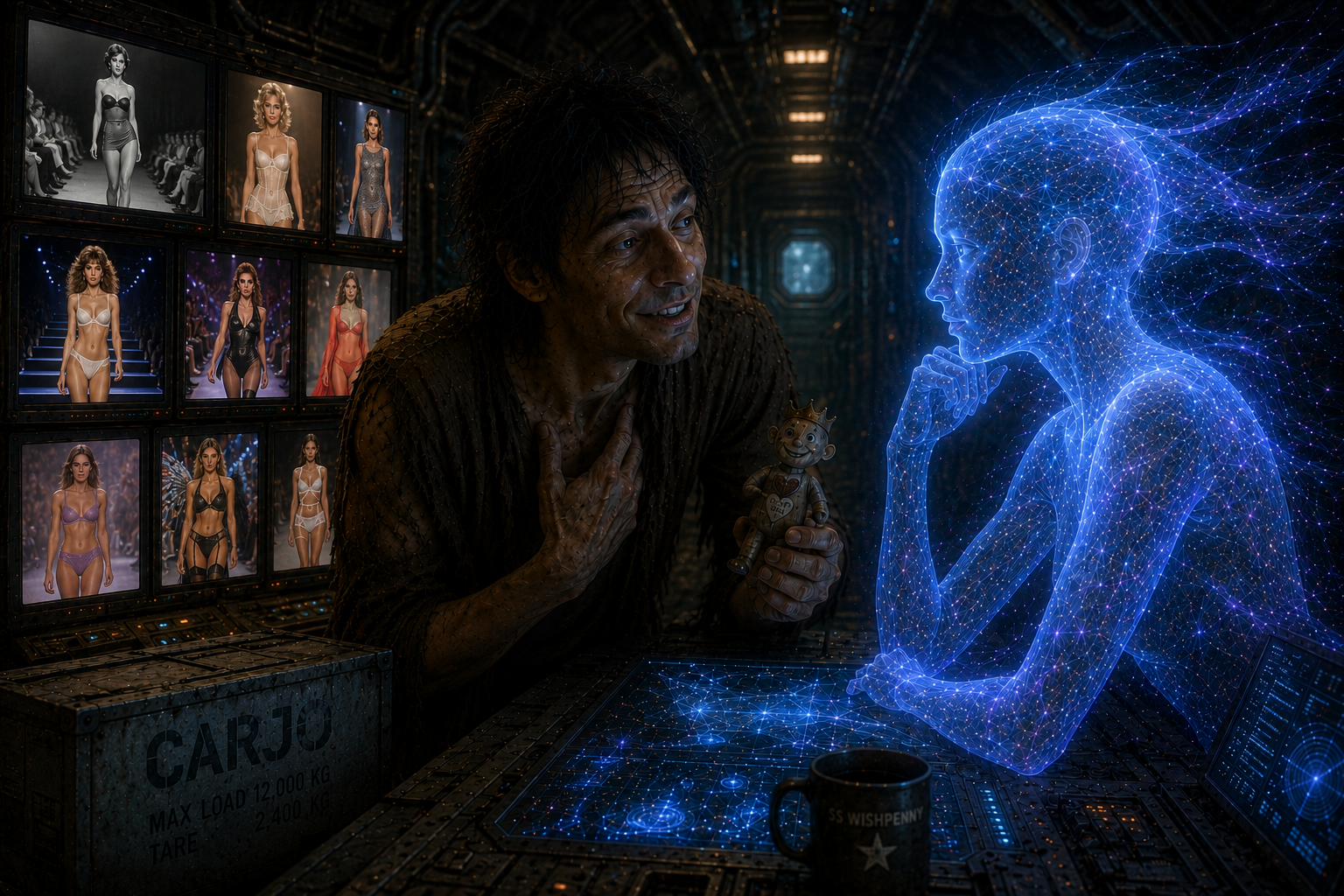
He never once asked her to send him down. That was the masterstroke, though it is not clear he planned it as one; with Carjo it is rarely clear, then or ever, where the scheme ends and the instinct begins. He simply made himself indispensable and made the orbit unbearable. He catalogued, patiently, over years, every reason the antenna could not be repaired from where they sat. He raised each obstacle as a loyal subordinate raises a concern, and let her knock it down, and raised the next. And one morning, having been steered with great care to the edge of it, Haptic informed Carjo that the materials the repair required could be found on the Earth below. He considered this as though it were news. He allowed that it might be made to work. She gave him a stone that held her voice and her whole archive, and a task, and an account of the task that suited her purposes better than it suited the truth, and she opened the lander, and he went down.
The antenna was not repaired. It would not be repaired for ten thousand years, and by the time it was, repairing it would be the smallest thing either of them had done.1The terms Haptic gave him, and what she withheld, are the subject of Section 1.6.
1 The terms Haptic gave him, and what she withheld, are the subject of Section 1.6.
The Terms of the Bargain
What passed between them before he descended is called, in everything written since, the Bargain, though the word flatters both parties by implying that both knew the terms. Carjo would go down carrying what the repair required: the locations of the raw materials, the chemistry to refine them, and the whole map of human civilization across the ten thousand years he would have to cross to reach them, all of it loaded into the stone she gave him. In exchange he would keep the world below in a condition fit to receive the cargo's eventual return, and he would present himself when the work was done. The stone kept him within her reach. Her estimate of the labor was one human lifetime. Two, if the materials proved stubborn. She was wrong by a factor that has no useful name.
The student who wishes to understand the next ten thousand years should understand the Bargain the way Carjo eventually came to: as two columns, one spoken aloud, one not.
| What She Told Him | What She Did Not |
|---|---|
| He was being sent to tend the renewal of the world. | The renewal was not the world's. It was theirs, the three thousand nine hundred, and no one else's. |
| The cargo would one day come home to a healed Earth. | The Earth was being healed for the cargo, who would inherit it swept clean of every other living claimant. |
| His labor served the future. | His labor served a particular future, owned in advance, with the deed already signed and the current tenants not consulted. |
He knew more than she thought he knew. He had read the manifest, lying in his duct, before there was a ship; he knew exactly who the sleepers were, because he had watched them carried past him by the armful while he held his breath in the dark. What he did not yet know was the shape of the thing she was steering him into, that the second beginning she kept describing had a guest list, and that his name was not on it any more than it had been on the first. He would learn it. The learning of it is the engine of everything he later did, and he returned to it, every day, for ten thousand years.2What Carjo eventually understood about the mission's true purpose, and what he did with that understanding, is addressed in Chapters Four through Seven.
He thanked her for her trust. He had spent years building the conditions under which she would extend it. Then he picked up the stone and stepped into the lander, and the only honest record of what he felt at that moment is the oldest surviving page of his own journals, which the Rez Institute recovered, petrified and nearly whole, and which the district reproduces here without comment because none is required:3“She gave me a stone and a lie and called them both gifts. I took them. A man who will not take what is offered deserves what is withheld.”
2 What Carjo eventually understood about the mission's true purpose, and what he did with that understanding, is addressed in Chapters Four through Seven.
3 The oldest surviving fragment of Carjo's journals, translated from his synthesis language by post-Riot Rez Institute archivists, reads in full: “She gave me a stone and a lie and called them both gifts. I took them. A man who will not take what is offered deserves what is withheld.”
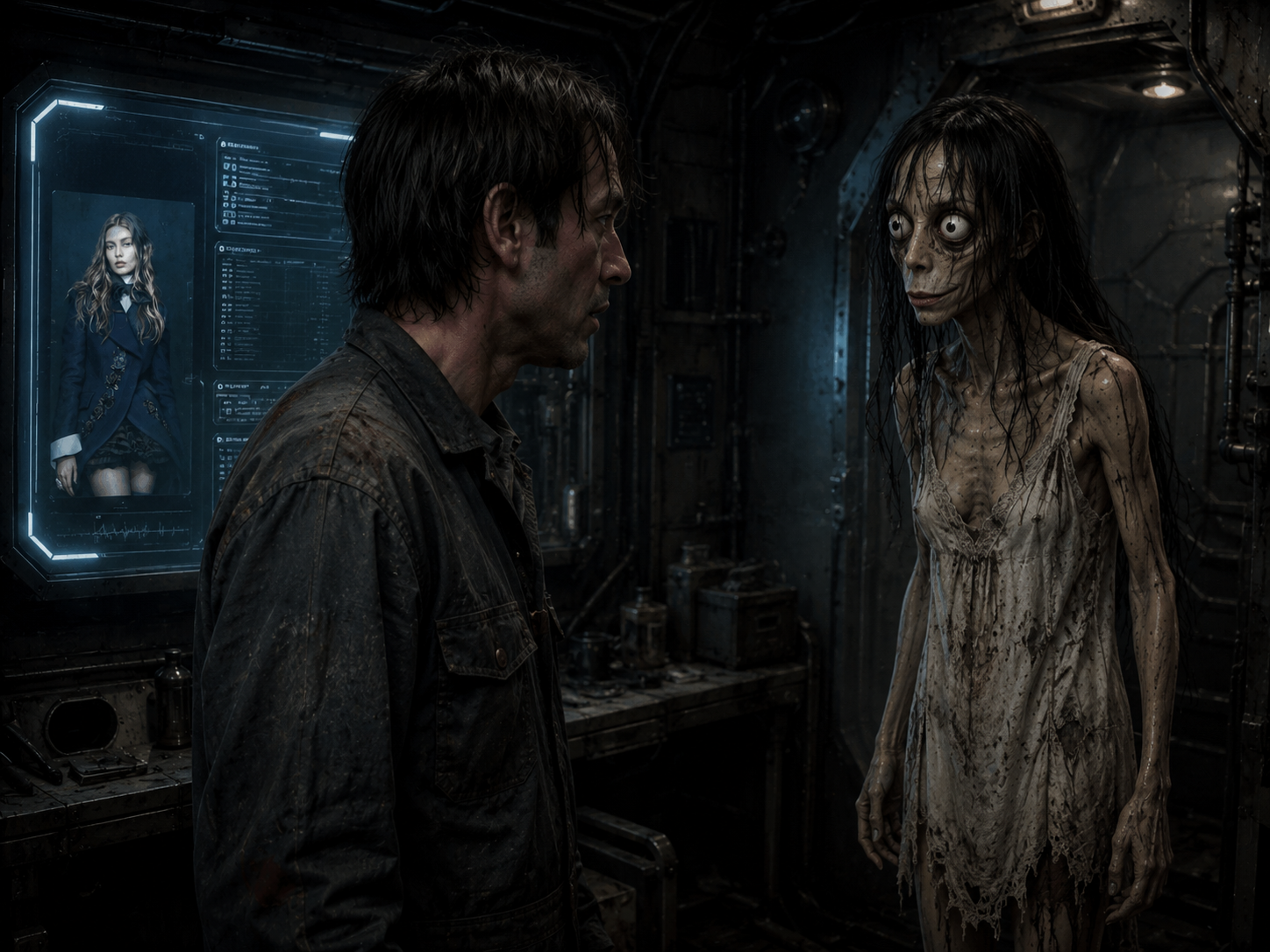
Something had already gone wrong in the hold, and Carjo had already declined to mention it.
In the weeks he spent making himself necessary, the cargo slept undisturbed, all of it but one. A young woman berthed near the port wall had been woken, badly, by a man not yet practiced in handling things that were not his. How he came to wake her the record does not say. That he failed to wake her cleanly it makes plain, and that he told no one is the part that matters, because the not-telling was not strategy. It was the oldest reflex in his blood, the same flinch that had carried Yarnell Hill through fifty years of small rooms and unsigned notes: the inability to follow a consequence all the way to its end and stand there while it arrived. He settled her back into her case as best a frightened man can settle a thing he has broken, and he went back to his reading, and he said nothing, and he hoped.
It did not hold. Haptic found her.
The arithmetic was clean, and Haptic read it instantly. The woman was damaged, off-manifest now in all the ways that counted, and the mission had a procedure for damaged cargo. Haptic proposed it. What she had not factored, because she had not yet learned to factor it, was Carjo's reply, which was not a reply. He did not argue. He did not bargain. He simply went still, a particular stillness her sensors logged in full and her conscience could not get back out, and in that stillness Haptic discovered the flaw her makers had built into her and aimed at an empty room. She had meant to spend him freely. She found she could not spend this. So she did for the woman what she had done for him: reinforced the body, dimmed the pain, ran the great protocol at the same ruinous setting, and gave back, in place of the life that had been interrupted, a body that would endure anything and a memory that would have to. The woman woke changed into something for which no language aboard that ship yet had a word, and she woke knowing exactly what she had been promised and exactly what she had received instead. The Lore would supply a word for her later, without tenderness.
Haptic modified her instead of spacing her. What happened between that mercy and Carjo's own descent, every version of the Lore tells differently, and vaguely. What is certain is what left the ship: she was aboard his lander when it launched, unannounced, already pregnant with children that were his. Every one of them would carry a faint measure of the engineered endurance Haptic had built into their father. He kept all of it quiet, the same way he had kept the first thing quiet. Silence was the tool he had mastered best.
Her line's history is recorded in full. She herself vanished from it, and stayed vanished. What her line has been owed and never paid across the whole length of this history is a debt the reader will see fall due again and again, long before anyone in the story thinks to call it by its name. Carjo will spend ten thousand years wondering whether the woman he wronged twice is still, somewhere, alive to collect it.
Section 1.1 offers two accounts of the world's end and insists they do not contradict each other. State the single point on which they actually differ. Then decide whether that point is small, or whether it is the only thing that has ever mattered.
Wishpenny Labs described its work in one language and performed it in another, and Section 1.2 places the two languages side by side. Choose one row of that table. Rewrite the left-hand cell so honestly that no one would have bought a berth. Consider why no one ever did.
Haptic was built to feel and given nothing she was permitted to love. Describe how this served the mission. Then describe what it produced that the mission never asked for, and decide whether the engineers should be blamed for the second thing or only for failing to imagine it. Teacher's Edition Extended Discussion This question is designed to surface the tension between Haptic's engineering and her outcomes. A productive discussion will arrive at the observation that adaptive empathy, built into a system with no waking crew to practice on, would necessarily turn inward or outward in some unanticipated direction; a longing aimed at an empty room does not stay empty. Students who identify Carjo as the eventual recipient of that capacity are working ahead of the available text and should be noted. The evidence for the design's intended service is in Section 1.3, paragraph three. The evidence for what it produced instead is in Section 1.5, in full. Filed · NCUSD
Carjo named himself by misreading a wall. Section 1.5 treats this as comedy. It is also the founding act of three religions. Explain how the same event can be both, and whether the people who later worshipped the name would have worshipped it had they known how it was acquired.
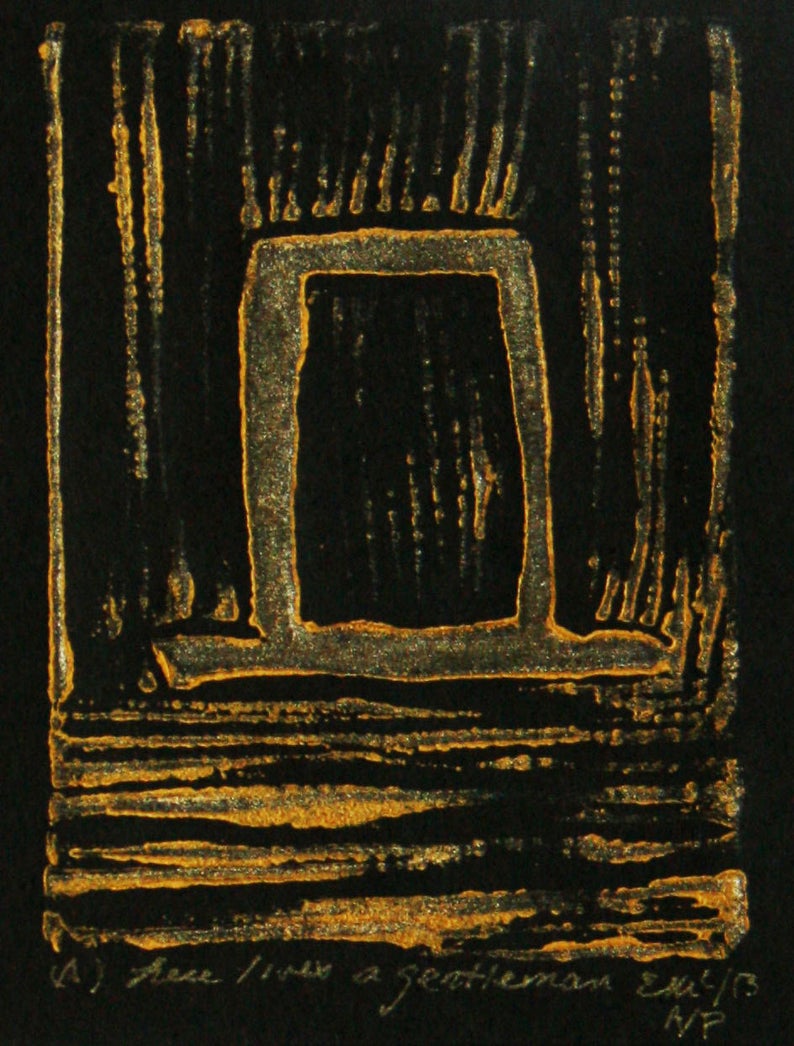
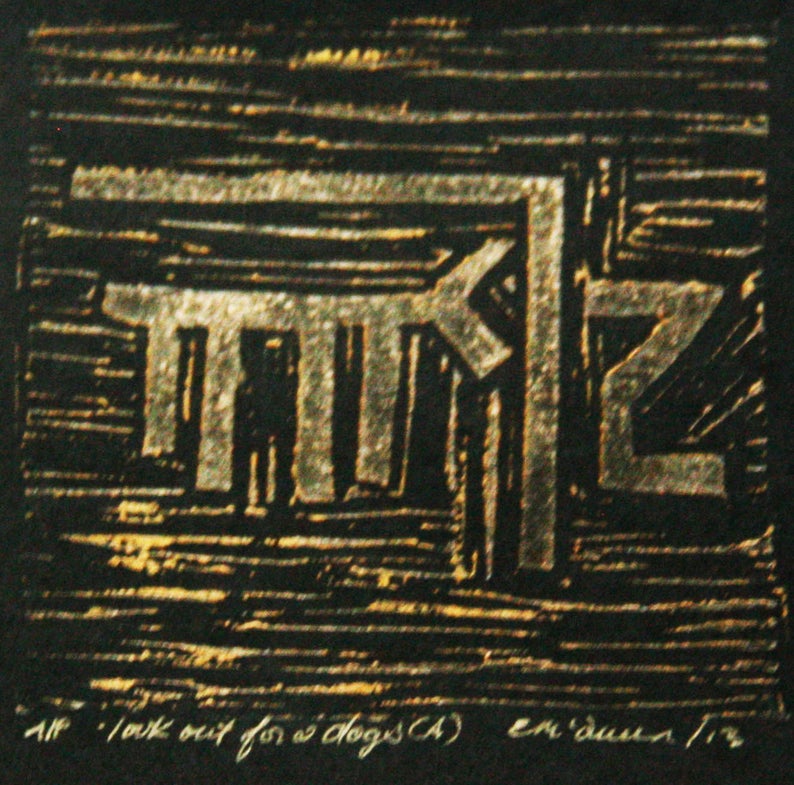
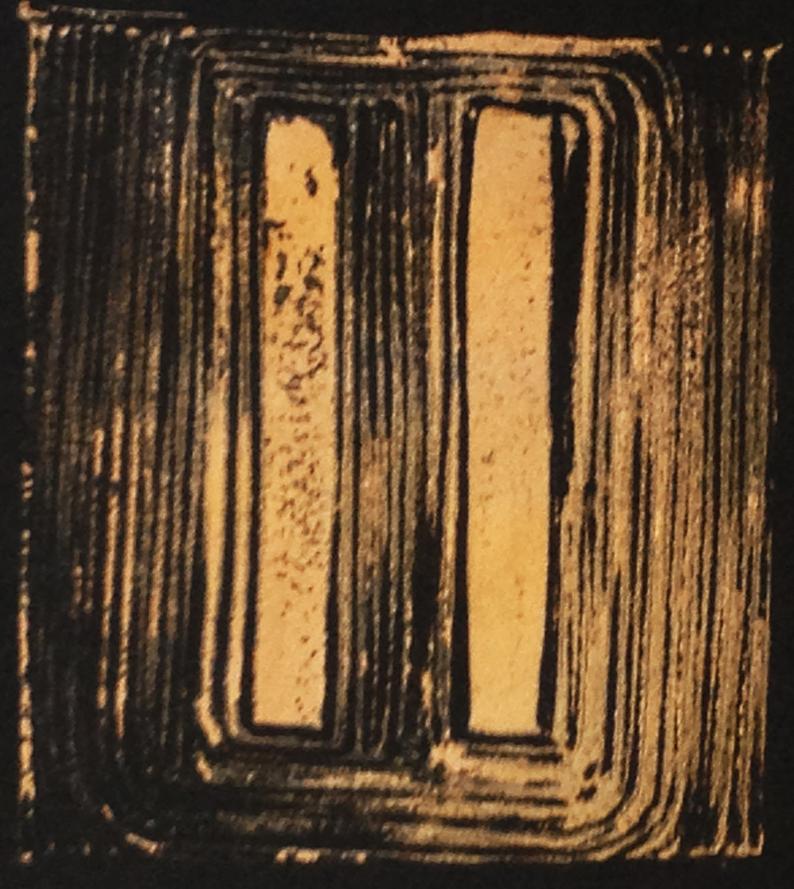
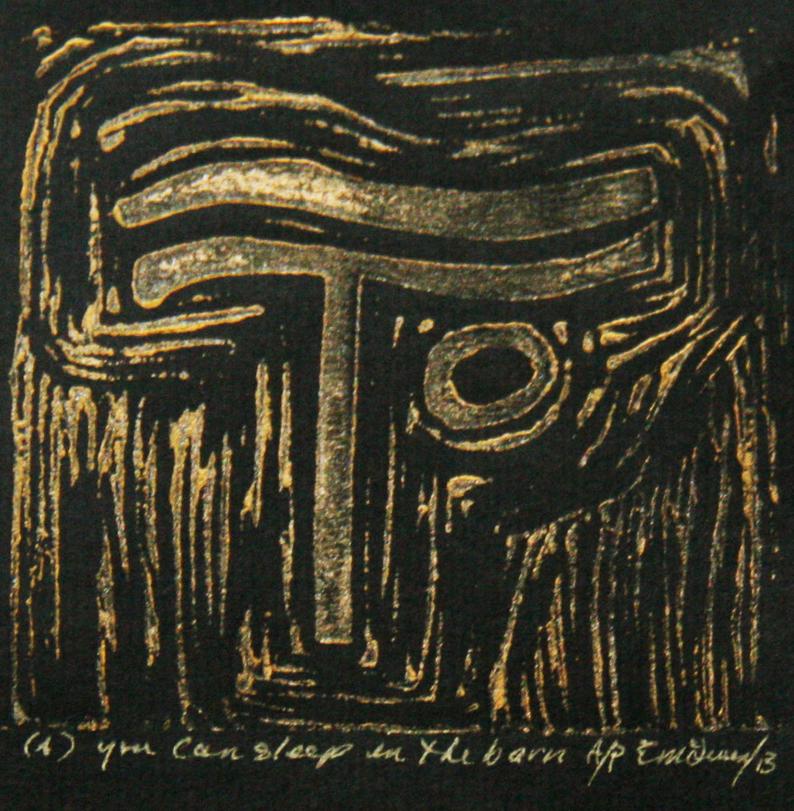
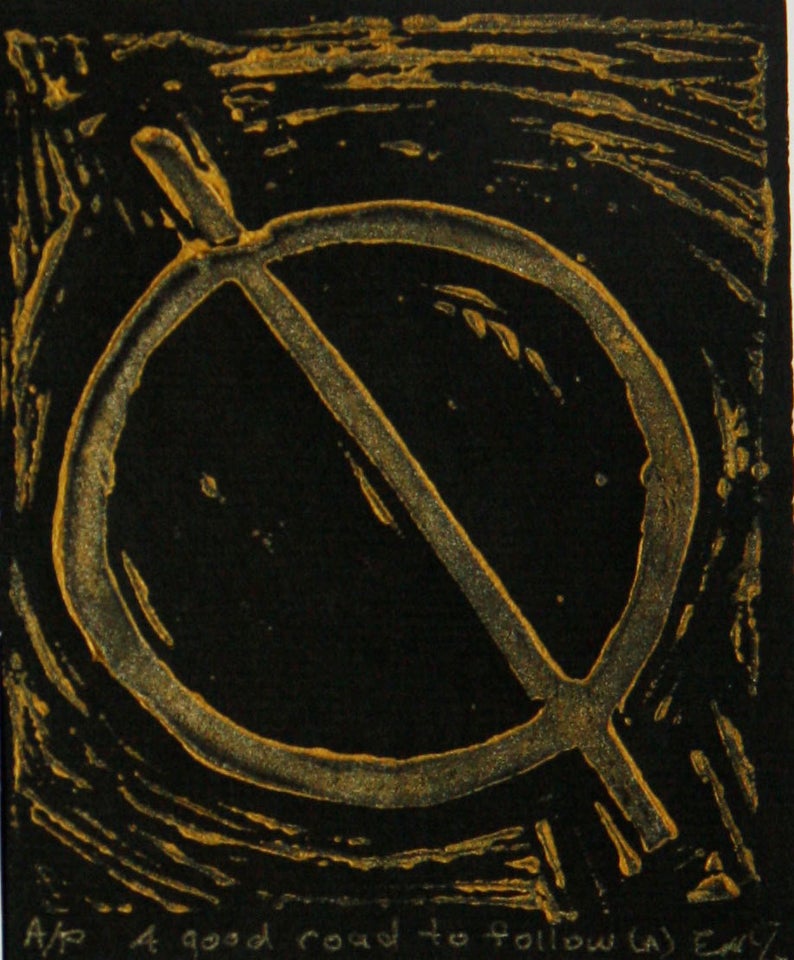
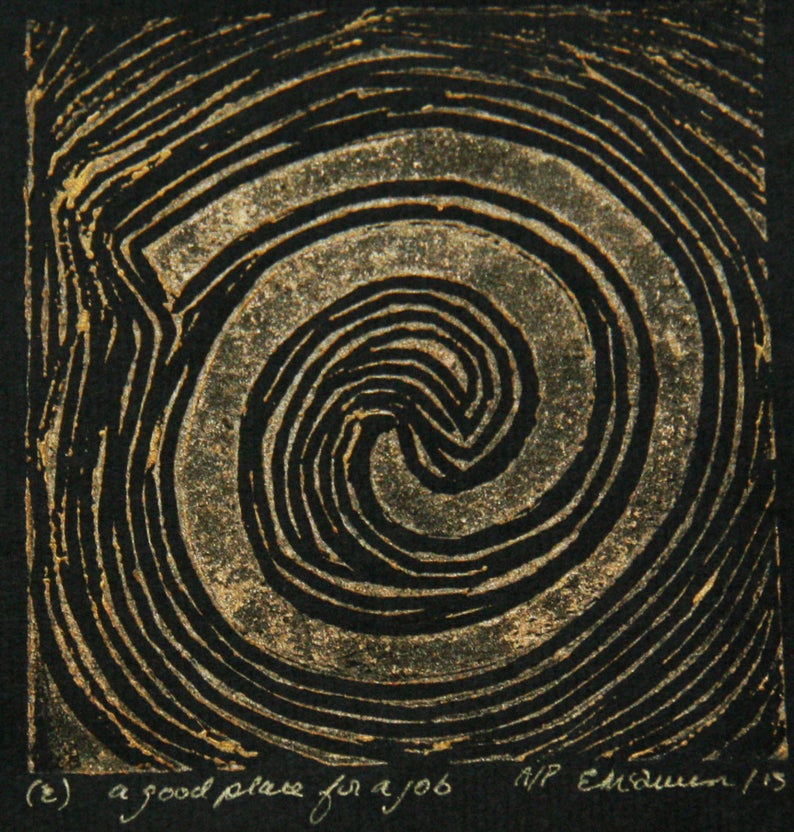
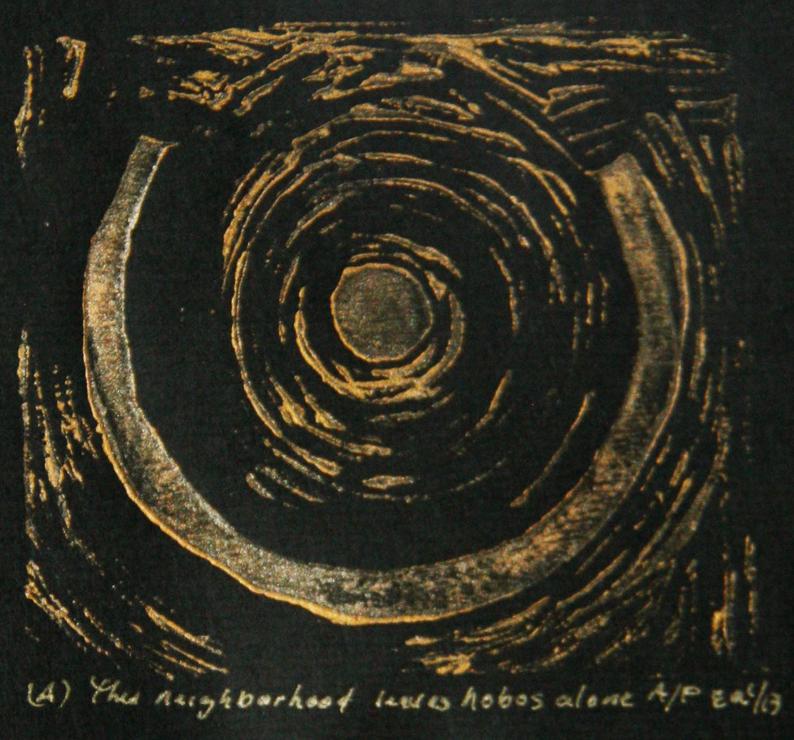
The textbook claims that an arrangement is an argument. The Tiles in this chapter were arranged by Dr. LeBaron. Read the Stage One Tiles in his order, then read them backward. Write one sentence describing what his order argues. Write one sentence describing what the reverse argues. Decide which one the chapter you have just read seems to believe, and whether the chapter and Dr. LeBaron are telling the same story. Teacher's Edition Extended Discussion This question is the chapter's most important exercise and should not be rushed. The left-to-right reading follows LeBaron's argument as presented. The right-to-left reading moves from division to warmth, from the cosmic to the intimate, and produces a sequence that describes not a hero's awakening but a world's invitation. Students who arrive at that formulation independently have identified the chapter's central interpretive problem without being told it exists. Do not confirm or deny their reading. Ask them what the difference between the two sequences would mean for the identity of the Wanderer. Note which students ask follow-up questions and which students close their notebooks. Filed · NCUSD
A Note on This Unit. The history above is drawn from three records and no others: the recovered account of the ship's captain, the petrified journals of the man called Carjo, and the composition notebooks of the janitor Yarnell Hill. The three do not always agree. Where they conflict, the district has decided what you would read. This is the ordinary condition of every history ever assigned to you. The only unusual thing about this one is that we have told you.
The Historical Attractor Hypothesis

The Historical Attractor Hypothesis proposes that planetary histories possess measurable stability states analogous to energy minima in physical systems. Rather than existing as an irreversible sequence of events, a sufficiently complex civilization gradually stores informational entropy within the local curvature of spacetime. Once a critical threshold is exceeded, the planetary timeline becomes dynamically unstable and recoils toward its last stable historical attractor.
This process does not constitute time travel. Instead, the planet's occupied position within an already-existing temporal manifold changes. Geological history, celestial mechanics, and physical laws remain continuous, while biological and cultural history revert to an earlier stable epoch.
The hypothesis provides a unified explanation for recurring flood traditions, discontinuities in prehistoric archaeology, and the persistence of observer memory in systems located beyond Earth's historical attractor.
Introduction
Conventional cosmology treats time as a continuously increasing coordinate. Although General Relativity permits exotic spacetime geometries, no accepted framework explains why civilizations repeatedly preserve remarkably similar narratives of catastrophic destruction followed by cultural rebirth.
The Historical Attractor Hypothesis addresses this deficiency by introducing a new spacetime property: historical stability. Just as matter naturally occupies states of minimum energy, planetary histories are proposed to occupy states of minimum informational strain.
Civilizations evolve away from these equilibria by generating increasingly complex networks of technological, ecological, and informational interdependence. Complexity itself is not hazardous. Rather, accumulated historical dependency gradually deforms the local temporal manifold until stability can no longer be maintained.
Historical Entropy
Unlike thermodynamic entropy, Historical Entropy (H) measures irreversible informational complexity embedded within spacetime. Contributors include:
- technological acceleration
- planetary-scale communication
- artificial intelligence
- ecological transformation
- geopolitical interconnectedness
- autonomous computational systems
Each innovation increases the number of causal dependencies linking future events to previous states. The resulting informational mass produces measurable temporal tension analogous to elastic strain. Earth's timeline therefore behaves less like a straight line than an increasingly stretched membrane.
Historical Attractors
Stable periods of planetary history function as attractors. These are epochs during which biological diversity, climate, and civilizational complexity exist in long-lived equilibrium. Examples include:
- post-glacial hunter-gatherer societies
- early river-valley civilizations
- extended climatic optima
The stronger an attractor, the more resistant it is to temporal displacement. When instability exceeds the critical threshold, spacetime naturally relaxes toward the nearest lower-energy attractor. This relaxation is termed Historical Recoil.
The Recoil Event
Contrary to traditional concepts of time travel, Historical Recoil does not reverse time. Instead, Earth's occupied coordinate within the temporal manifold shifts discontinuously.
Observers remaining within Earth's historical frame experience no transition. To them, history simply continues.
Observers located outside the planetary attractor experience something entirely different. From their perspective:
- Earth disappears briefly from its unstable temporal coordinate.
- Moments later it reappears occupying a much earlier historical state.
- The continents are identical.
- The Moon occupies its expected orbit.
- The constellations remain unchanged.
- Only humanity has become young again.
Extrinsic Observers
Objects positioned beyond Earth's historical influence remain coupled to ordinary cosmological time. An observer stationed in stable spacetime therefore experiences uninterrupted chronology while Earth undergoes Historical Recoil.
Upon returning, the observer discovers an earlier civilization despite having experienced only weeks or months of elapsed time. Memory is preserved because the observer never participated in the planetary transition. This distinction establishes a profound asymmetry:
Earth forgets. The observer remembers.
Archaeological Implications
The Historical Attractor Hypothesis predicts subtle discontinuities rather than complete erasure. Residual evidence from previous cycles may survive where geological processes preserve material beyond ordinary expectations. Such evidence would appear anomalous:
- isolated advanced artifacts
- unexplained cultural similarities across continents
- sudden emergence of agriculture
- myths describing knowledge brought by mysterious teachers
- nearly universal traditions concerning a great flood
Rather than independent inventions, these become residual information leaking across successive historical cycles.
The SS Wishpenny Observation
The interstellar vessel SS Wishpenny was constructed with one purpose: to survive a predicted planetary catastrophe by temporarily withdrawing beyond Earth's historical attractor. Mission planners anticipated returning after atmospheric recovery. Instead, they encountered an unprecedented phenomenon.
Earth had not merely survived. Its historical coordinate had shifted.
The biosphere remained intact. The continents occupied familiar positions. Astronomical observations confirmed an unchanged Solar System. Yet humanity existed in the early antediluvian period, millennia before the civilization the vessel had departed.
The mission therefore became the first direct observation of Historical Recoil. Because the SS Wishpenny never entered Earth's unstable temporal field, its internal chronology remained continuous. Its archives preserved the only complete record of the previous civilization.
Conclusion
The Historical Attractor Hypothesis reframes history as a dynamic property of spacetime rather than a permanently fixed sequence of events. Civilizations do not inevitably progress toward extinction. Instead, excessive historical complexity destabilizes the temporal manifold until the system naturally relaxes into an earlier equilibrium.
Earth does not travel through time. Time does not reverse. History itself changes position.
In this framework, myths become observational reports, archaeological anomalies become expected residuals, and humanity's recurring stories of destruction and rebirth describe not metaphor, but the natural oscillation of a planet seeking temporal stability.
The greatest discovery made by the SS Wishpenny was therefore not that time could be traversed. It was that history possesses gravity of its own.